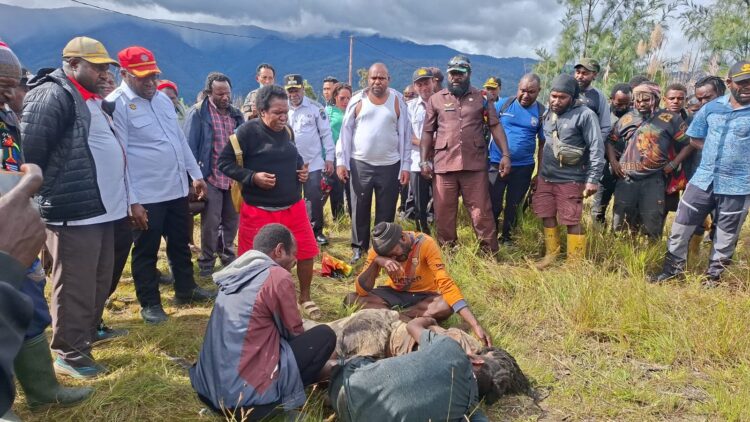
Jayapura, Jubi – Civilians continue to bear the brunt of the armed conflict between Indonesian security forces and the West Papua National Liberation Army (TPNPB) in Intan Jaya Regency, Central Papua Province.
Although clashes between the two sides have continued, it is civilians who have increasingly paid the highest price.
According to data compiled by the Papua Law and Human Rights Coalition, 14 civilians were affected by the conflict between May and July 2026. Five people were killed and nine others injured. The victims included three women and 11 men.

Most of the victims were adults, although several were children. The coalition also recorded the death of an unborn child after its pregnant mother was fatally shot.
Papuan politician Laurenzus Kadepa said the prolonged conflict has inflicted deep and lasting suffering on civilians.
“Intan Jaya remains one of the main flashpoints of tension in Papua. Armed clashes between security forces (TNI/Polri) and the TPNPB-OPM continue to recur, with civilians bearing the consequences,” Kadepa told Jubi on Thursday (July 9, 2026).
He said civil society groups and student organizations have continued urging Indonesia’s National Human Rights Commission (Komnas HAM) to conduct an independent investigation into the humanitarian impact of the conflict.
According to Kadepa, such an investigation is needed to assess the impact of security operations on local communities and review the deployment of military posts in residential areas.
Kadepa also called on the Central Papua provincial government and the regents of the province’s eight regencies to declare a humanitarian emergency.
He said such a declaration would provide the legal basis for authorities to mobilize emergency resources, assist victims, and meet the basic needs of conflict-affected communities without being constrained by normal bureaucratic procedures.
A former member of the Papua Legislative Council responsible for government, politics, law, human rights, and security affairs, Kadepa said declaring a humanitarian emergency is an official government mechanism to acknowledge a crisis that threatens the lives, safety, and well-being of a community.
He argued that the measure is particularly necessary in Intan Jaya and neighboring Puncak Regency, where it would allow provincial and district governments to respond more rapidly to the needs of civilians displaced by the conflict.
“It would enable emergency funds to be released, humanitarian supplies to be delivered, and emergency kitchens to begin operating immediately. Internally displaced people in Puncak and Intan Jaya need assistance today, not after next year’s budget is approved,” he said.
Kadepa also argued that a humanitarian emergency declaration would allow humanitarian organizations, including the Indonesian Red Cross, the UN refugee agency (UNHCR), and international non-governmental organizations, to respond more quickly through official channels.
“Children living in displacement camps need doctors, shelter, and security—not speeches,” he said.
He added that declaring a humanitarian emergency could also increase pressure on all parties involved in the conflict to suspend hostilities, particularly armed clashes.
At the same time, Kadepa acknowledged that such a declaration would carry political consequences.
According to him, local leaders who declare a humanitarian emergency could face greater scrutiny from the central government and the international community. However, he said failing to do so would leave civilians to continue paying the human cost of the conflict, with more families displaced and civilian casualties continuing to rise.
Kadepa said regional leaders must demonstrate a sense of urgency, political courage, and the willingness to set aside bureaucratic considerations to save lives.
“People are not asking local leaders to oppose the state,” he said. “They are asking them to protect their citizens in accordance with the law. Declare a humanitarian emergency so the world understands what is happening in Central Papua. Let humanitarian assistance arrive quickly, and let the fighting stop, at least temporarily.”
Kadepa said a lasting solution to the conflict in Intan Jaya and other parts of Papua requires a fundamental shift away from a security-based approach toward meaningful dialogue.
“As long as the root causes of the conflict remain unaddressed, the violence will continue,” he said.
The Papua Law and Human Rights Coalition also documented a series of incidents between May and July 2026 that it says resulted in civilian casualties.
According to the coalition, an explosive device allegedly dropped by a drone detonated in the yard of a church on May 17, killing one person and injuring four others. On June 18, two women, Aliana Pogau and Ottopina Hogajau, were seriously injured after another explosive device was allegedly dropped by a drone in Danggoa village.
The coalition said Makelon Majau was wounded by shrapnel on June 23 after an explosive device allegedly struck a residential area in Balamai village, Hitadipa District.
On June 29, Daud Hagisimijau and Kiko Hagisimijau were reportedly shot while operating heavy equipment transporting construction materials for a Catholic church in Titigi village. The coalition alleged that members of the Indonesian Military (TNI) were responsible for the shooting.
The same day, evangelical minister Elianus Agimbau was reportedly killed by gunfire near the Mbamogo motorcycle taxi terminal.
On July 1, the body of Okto Tigau was found with multiple gunshot wounds and stab injuries, according to the coalition.
The coalition also reported that Melkiana Duwitau, who was seven months pregnant, was killed inside her home during an exchange of gunfire near Sugapa on the night of July 2. It said her unborn child also died.
The coalition said the incidents indicate possible violations of Article 3(1) of the 1949 Geneva Conventions, which provides minimum protections for civilians during armed conflict.
It said a formal complaint was submitted to Indonesia’s National Human Rights Commission (Komnas HAM) on July 3, 2026, under registration number 163883.
The coalition called on Komnas HAM to exercise its investigative authority under Articles 18 and 19 of Law No. 26/2000 on Human Rights Courts to investigate the incidents.
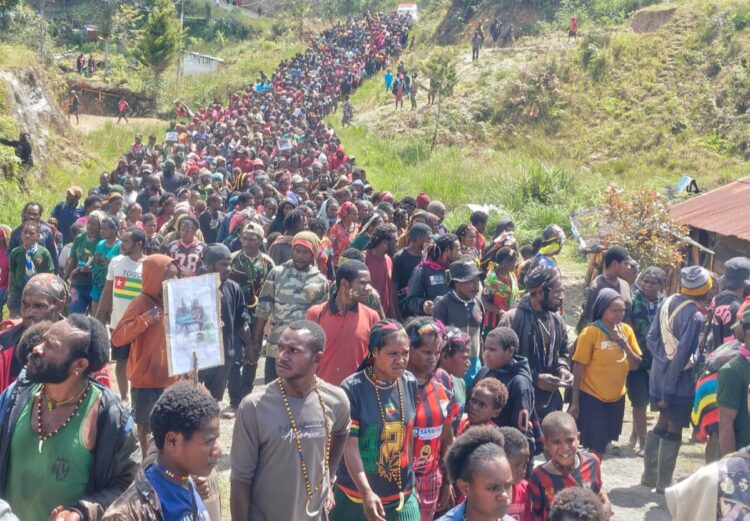
Civilian deaths in armed conflict are a humanitarian tragedy, Komnas HAM says
Indonesia’s National Human Rights Commission (Komnas HAM) said the deaths of civilians during armed clashes between the West Papua National Liberation Army (TPNPB) and Indonesian security forces in Intan Jaya Regency, Central Papua Province, constitute a humanitarian tragedy and a violation of the right to life.
Komnas HAM Chair Anis Hidayah said the commission has gathered preliminary information and is monitoring recent armed clashes in Intan Jaya.
“The deaths of civilians resulting from security operations or armed clashes constitute violations of the right to life. These incidents must be investigated,” Hidayah said.
She said the right to life is a fundamental, non-derogable right that cannot be restricted, even during states of emergency or armed conflict.
The principle is protected under Article 6 of the International Covenant on Civil and Political Rights (ICCPR), which Indonesia ratified through Law No. 12/2005, as well as Articles 28A and 28I of the 1945 Constitution.
According to Hidayah, even in situations resembling a non-international armed conflict, the principles of international humanitarian law remain applicable as legal and ethical standards.
She said all parties to the conflict are obliged to distinguish between combatants and civilians and must not turn residential areas into battlefields. Security operations, she said, should be conducted in ways that minimize risks to civilians.
“The fact that these incidents occurred in residential areas points to a collective failure to uphold these principles, regardless of which party fired the fatal shots,” she said.
Hidayah added that the prolonged conflict in Intan Jaya has disproportionately affected vulnerable groups, including women, children, pregnant women, and older people, many of whom are unable to flee conflict zones or access emergency healthcare.
She said the incidents also affect the right to health—including reproductive health—and children’s rights, including the loss of unborn children in cases where pregnant women are killed.
According to Komnas HAM, the recurrence of similar incidents across Papua in recent years reflects weak accountability for violence against civilians.
Without transparent legal proceedings and clear accountability, Hidayah warned, the situation risks perpetuating impunity and further eroding public trust in state institutions and efforts to resolve the conflict.
Komnas HAM called for an immediate halt to armed clashes in residential areas, stressing that both security forces and armed groups have an obligation to avoid involving or endangering civilians during their operations.
The commission also said the repeated occurrence of such incidents indicates a broader structural problem rather than isolated cases, requiring a comprehensive review of the government’s security approach.
Papua legislator calls for withdrawal of non-organic security forces
Central Papua Legislative Council member Thobias Bagubau, who represents Intan Jaya, called on President Prabowo Subianto to order the withdrawal of non-organic security forces from the regency.
Bagubau said the recent series of violent incidents in Intan Jaya has resulted in civilian casualties.
“President Prabowo Subianto must evaluate and withdraw the [non-organic] military forces from Intan Jaya,” he said.
He said that as commander-in-chief, Prabowo, together with the Minister of Defense, the commander of the Indonesian Military (TNI), and the national police chief, should immediately review the deployment of security forces across Papua, particularly in Intan Jaya.
According to Bagubau, security personnel operating in the Central Papua Highlands and Papua Highlands provinces have placed civilians at risk.
The Hanura Party politician alleged that security forces have failed to distinguish between legitimate military targets and civilians during operations.
“They are not distinguishing between religious leaders, mothers, children, and ordinary civilians,” he said. “Instead of focusing on their primary adversary, the TPNPB-OPM, civilians are becoming the targets.”
Bagubau said that if the central government fails to act, he would push for greater international attention to the situation.
He proposed allowing international media access to Papua to report on developments in the region, including the activities of Indonesian security forces.
Meanwhile, the Central Highlands Students Association (IMPT) in Manokwari, West Papua Province, together with the Indonesia-wide Intan Jaya Students Movement (GPMI-I), condemned violence against civilians in Intan Jaya and called for all perpetrators to be prosecuted in accordance with the law.
The student organizations also urged local authorities and the Intan Jaya Legislative Council to facilitate an investigation by Komnas HAM into the Soanggama case and other alleged human rights violations in the regency.
They further called on the district government and local legislature to facilitate direct dialogue between students, Intan Jaya community leaders, President Prabowo, and the Minister of Defense to discuss efforts to resolve the conflict.
The groups also urged the President, the Minister of Human Rights, and other relevant ministries to take concrete steps to address humanitarian issues in Intan Jaya and other conflict-affected areas across Papua.
IMPT Manokwari and GPMI-I called on the central and regional governments, state institutions, religious and customary leaders, civil society organizations, academics, the media, and the wider Indonesian public to pay greater attention to the humanitarian situation in Intan Jaya. (*)