Jayapura, Jubi – A member of the Central Papua Legislative Council has warned that efforts to crack down on illegal gold mining in Central Papua must not come at the expense of Indigenous landowners.
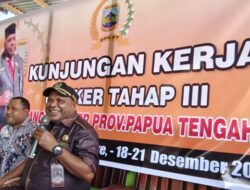
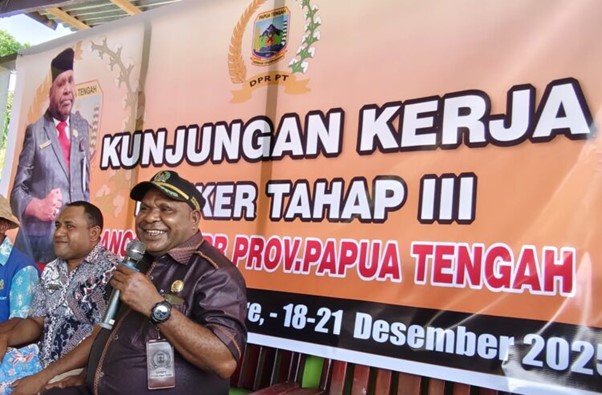
Thobias Bagubau, a legislator representing Intan Jaya and a member of Commission B from the Papua Bangkit faction, made the statement following a working visit to Nabire by Indonesia’s Defence Minister, the military commander, the National Police chief and the Attorney General on Thursday, 22 October 2026. The visit was aimed at addressing gold mining in the province.
Bagubau questioned the real purpose of the visit, asking whether it was genuinely intended to regulate illegal mining or whether other interests were involved.


“If they genuinely intend to crack down on illegal gold mining conducted by irresponsible people because it harms the state, that is fine. But there must not be other interest behind it. We must not allow other companies to move in and end up harming Indigenous communities,” Bagubau said in a voice message received by Jubi on Sunday, 25 October 2026.
The Hanura Party politician acknowledged that illegal gold mining was taking place in several parts of Central Papua, including around kilometre 107 along the Trans- Papua Road and in Makimi, Nabire Regency; along the Degeuwo River in Paniai Regency; and at several sites in Intan Jaya Regency.
“Miners have entered these areas without official permits from local authorities. I support the government’s policy to regulate illegal mining, including President Prabowo Subianto’s measures. But, in principle, there must not be any hidden interests between them,” he said.
Bagubau said visits by central government officials were legitimate, but Indigenous landowners’ had the right to object if authorities failed to consult them.
“These are not empty lands. They belong to Indigenous landowners. Papua is not empy land. The state may claim this territory as part of Indonesia, ad that is its position, but there are consequences and risks in the future,” he said.
He also raised concerns about the revocation of mining company permits in Nabire and the transfer of their concession areas to state-owned mining company PT Aneka Tambang (Antam) Tbk.
Bagubau said the presence of the Forest Area Enforcement Task Force (Satgas PKH), which had been operating in Central Papua for only a few months, appeared to be leading to a forced takeover of land in the interests of the state.
“It seems as though they have a well-planned strategy. They arrive, deploy personnel and impose restrictions. I am worried that after miners and residents around the sites are restricted, the land will be used for the interests of state-owned enterprises. What will Indigenous communities gain?” he said.
He argued that claims that special autonomy funding had been provided and communities empowered were not reflected on conditions on the ground. Instead, he said, Indigenous communities continued to suffer losses and the environment in Papua was being damaged.
Bagubau pointed to previous cases in which Indigenous communities had borne the cost development, including in Merauke Regency in South Papua province.
He also alleged that illegal mining operations in Central Papua were often monitored by individual security personnel, while Indigenous communities living around the sires suffered the consequences.
“That is what I learned from advocating on illegal mining in Bayabiru and along the Deguwo River. Those experiences have taught me a lesson,” he said.
Bagubau, who leads the Walani, Mee and Moni Indigenous Community Development Institute (Swamemo), also expressed concern that more Indonesian military (TNI) posts could be established around mining sites.
“Your land is taken. Your timber is taken in the name of the state. When you try to act, you have to face military personnel. More TNI posts are established. That means a real threat is emerging on Indigenous land in Papua,” he said.
He urged the central government to focus on regulating illegal mining without allowing companies to occupy the same areas under the protection of military and police personnel.
He also called for transparency and consultation with Indigenous landowner, warning against authorities claiming control of territories solely in the name of national interests.
Bagubau questioned the Defence Minister’s decision to visit Central Papua, arguing that the minister’s responsibilities would be better served by visiting border areas such as the Papua New Guinea border, Merauke and Oksibil.
If visiting Central Papua, he said, the minister should instead inspect road construction, budget allocations and community welfare in Indonesia’s newly established provinces.
He urged the Central Papua provincial government and relevant agencies, including the mining and environmental departments, to document illegal mining locations and areas claimed by the central government through the Forest Area Enforcement Task Force.
He also called on the executive, legislature, judiciary and the Papuan People’s Assembly (MRP) to address the issue collectively.
Bagubau advised Indigenous communities and customary landowners to carefully consider the consequences before accepting or rejecting the presence of the state and companies on their land.
“Do not let them sign agreements and accepts these arrangements only to end up as sacrificial victims. They could be sacrificed on their own land. I want to emphasise that things are not all right in Papua, and Papua is not empty land. This is a matter that demands serious attention,” he said. (*)
Author

About The Author