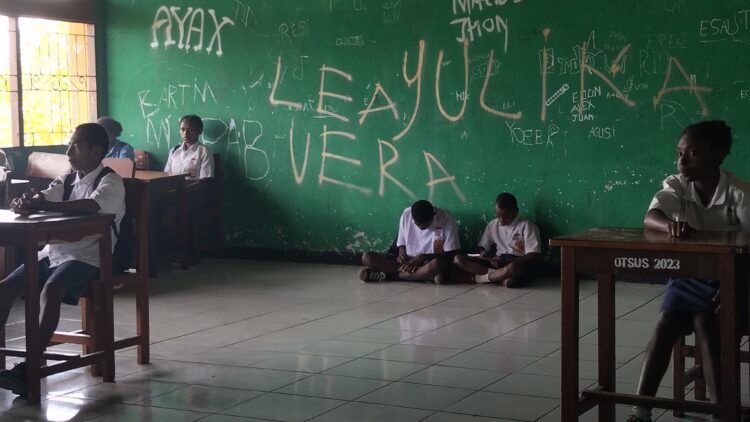
Sentani, Jubi – Conditions at many schools in Jayapura Regency, Papua, are concerning. Some schools no longer have adequate desks, tables or chairs, while many also lack proper libraries and laboratories. The quality of education in Jayapura Regency is increasingly at risk as poor facilities hamper teaching and learning.
On Wednesday morning, July 29, 2026, students were attending a science lesson in the science laboratory at Kemtukgresi National High School, in Ibub village, Kemtukgresi District, Jayapura Regency, Papua. They listened as Navalia, a science teacher at the school, explained the lesson.
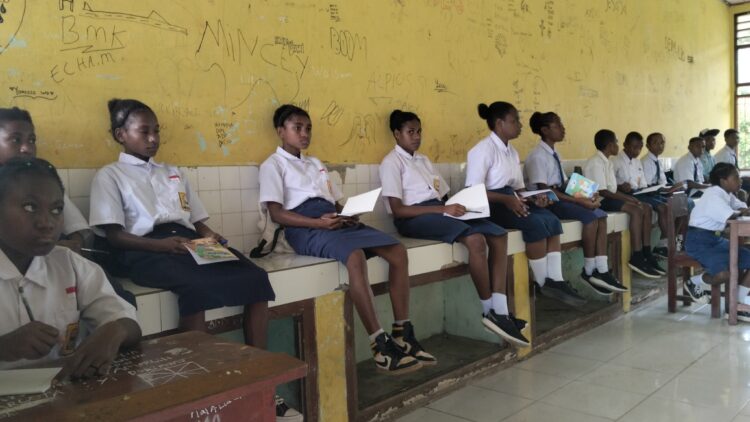
Instead of sitting on chairs and taking notes in books on desks, most of the students sat on a tiled concrete bench built into the wall. Some held their notebooks in their hands, trying to concentrate on Navalia’s explanation while taking notes without a desk.

There were simply not enough desks or chairs in the laboratory. The concrete bench was also empty of laboratory equipment or teaching aids normally found in a school science lab. So, when the available desks and chairs could not accommodate all the students, the white-tiled concrete bench became their “seats”.
Navalia, who has taught at Kemtukgresi National High School for the past two years, said her students had become accustomed to the situation. She said teaching and learning continued despite some students having to sit on concrete benches or even on the floor.
“I previously taught at a school in Kaureh District, and the situation there was much worse,” Navalia said while speaking to Jubi between lessons.
Despite the limitations, Navalia continues to teach her students.
“This is not new. It has been going on for a very long time. The children have to attend every subject according to the school timetable. The important thing is that they come to school and learn,” she said.
Although she believed her students were attentive and that the lessons were still being delivered, Navalia acknowledged that the school’s laboratory was far from ideal.
“The impact is that what we can teach is mostly theory or verbal explanations. Students need supporting facilities such as teaching aids and other learning equipment, especially because this is a laboratory,” she said.
The condition of the science laboratory is a snapshot of the wider situation at Kemtukgresi National High School. Several classrooms also lack enough desks and chairs.
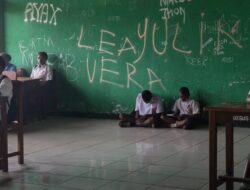
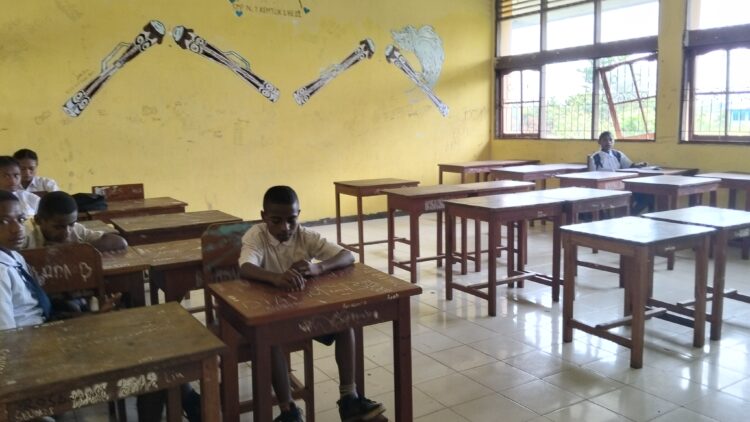
In Year 9, for example, two students were sitting on the floor on Wednesday morning, leaning against a green classroom wall covered in scribbles. Several other students shared chairs, while others sat on desks.
The ceilings in almost all the classrooms and corridors are badly damaged, with sections of the ceiling missing or full of holes. Some classrooms cannot be closed because their doors are missing.
There was no lesson in Year 7 that morning because the teacher had not yet arrived at school.
The school’s computer laboratory was the only facility considered to be in relatively good condition. The room, which is normally used by students to sit national examinations, can be locked and is relatively secure, with metal bars fitted to each window.
The room also has enough desks and chairs, while the computers are still functioning and are regularly used for teaching and learning.
A Year 7 student, Martince Hamongkwarong, comes from Braso village, about 10 kilometres away. Travelling by motorcycle taxi costs her 50,000 rupiah a day.
The transport costs faced by students such as Hamongkwarong are significant given the condition of the school’s facilities, but students in Kemtukgresi have few alternatives.
“As I said earlier, we don’t have a classroom teacher. There are only five chairs in our classroom, but there are 17 of us. When we study, some of us sit on desks and others sit on the floor,” she said.
The situation becomes even worse during the rainy season. The corrugated iron roofs leak in several places, and classes can be disrupted when rainwater pours into the classrooms.
“In Year 9, the classroom used by the older students is in the worst condition because there is no ceiling anymore and the roof leaks, so rainwater comes straight inside,” Hamongkwarong said.
Principal Yesaya Nero said most of the chairs, desks and tables at Kemtukgresi National High School were badly damaged and could no longer be used.
As a result, students attend lessons sitting on the floor, on desks, or on chairs without tables.
Yesaya said the school’s facilities and teaching equipment were initially in good condition and adequately supplied. Over time, however, much of the equipment and infrastructure had been damaged or disappeared.
Some chairs and desks with broken legs had to be removed from classrooms but were never replaced. Some classroom windows were broken, while some classroom doors were also missing.
In some classrooms, teachers have had to give their own desks and chairs to students.
“Teachers stand and teach in the classroom until the lesson is finished,” Yesaya said during an interview at the school.
Kemtukgresi National High School does receive government School Operational Assistance, known as BOS funding. However, Yesaya said the amount was not enough to pay for the repairs needed at the school, which serves hundreds of school-age children.
“There are 13 classes and 11 rooms being used by 384 students from Year 7 to Year 9. We receive just over 300 million rupiah in School Operational Assistance funding,” he said.
Reports made to authorities
The lack of teaching facilities and infrastructure at Kemtukgresi National High School has persisted for more than 10 years, since Yesaya first became principal.
He said the school had repeatedly proposed repairs and reported the condition of its facilities through the Basic Education Data system, known as Dapodik, which is updated every year.
Requests for new desks, chairs and other teaching equipment have also been submitted repeatedly through Musrenbang, the government’s development planning forums, from village to district level.
Yesaya said he had also regularly reported the school’s condition during visits by the Jayapura Regency Legislative Council’s Commission C, the Jayapura Regency Education Office and the Jayapura regent.
He had also proposed improvements through the central government’s programme to revitalise education infrastructure and facilities, but none of these efforts had produced results.
Kemtukgresi National High School is not the only school in Jayapura Regency struggling to repair damaged buildings or replace desks and chairs.
Similar problems, in varying forms, are found at many schools, including damaged buildings, shortages of desks and chairs, inadequate libraries and laboratories with equipment that can no longer be used.
Such conditions are increasingly common in districts far from the Jayapura Regency government centre, including Unurumguai, Airu, Kaureh and Ravenirara.
Fransiska Bairas, a contract teacher at SD Inpres Sawesuma in Unurumguai District, said her school building no longer had desks or chairs.
The building is now little more than floors, walls separating the classrooms and a roof, after its ceilings, doors and windows were either damaged or disappeared.
Despite this, Bairas said teaching and learning at Sawesuma Elementary School continued.
Amid the poor condition of the building and school facilities, students still travelled from various remote villages to attend school and remained committed to their studies.
Like Yesaya Nero, Bairas said the condition of SD Inpres Sawesuma had been reported repeatedly.
“The condition of the school has also been reported to the Education Office in Gunung Merah [the Jayapura Regency government office complex]. It has also been reported through Dapodik because, besides being a classroom teacher, I am also the Dapodik administrator. We submit the report every year,” she said.
Samuel Bayani, a resident of Braso village in Kemtukgresi District, said parents and students had complained about the poor condition of their schools for years.
He was also concerned that the quality of education in various villages was suffering because teaching was largely limited to theory, with students unable to take part in practical activities because the necessary equipment was unavailable.
The computer laboratory at Kemtukgresi National High School is the only facility considered to be in reasonably good condition.
The laboratory, which is normally used by students to sit national examinations, can be locked and is relatively secure, with metal bars fitted to every window. The room also has enough desks and chairs, while the computers are still functioning and regularly used for teaching and learning.
The school serves school-age children from several surrounding villages. One Year 7 student, Martince Hamongkwarong, travels from Braso village, about 10 kilometres away. She spends 50,000 rupiah a day on a motorcycle taxi to get to school.
The transport costs faced by students such as Hamongkwarong are significant given the condition of the school’s facilities, but students in Kemtukgresi have few alternatives.
“As I said earlier, we don’t have a classroom teacher. There are only five desks in our classroom, but there are 17 of us. When we study, some of us sit on the desks and others sit on the floor,” she said.
The situation becomes even worse during the rainy season. The corrugated iron classroom roofs leak in several places, and lessons can be disrupted when rainwater pours into the classrooms.
“The Year 9 classroom is in the worst condition because there is no ceiling anymore and the roof leaks, so rainwater comes straight inside,” Hamongkwarong said.
Principal Yesaya Nero said most of the chairs, desks and tables at Kemtukgresi National High School were badly damaged and could no longer be used.
As a result, students must attend lessons sitting on the floor, on desks or on chairs without tables.
Yesaya said the school’s facilities and teaching equipment were initially in good condition and adequately supplied. Over time, however, much of the teaching infrastructure and equipment had been damaged or disappeared.
Some chairs and desks with broken legs had to be removed from classrooms but were never replaced. Some classroom windows were broken, while some classroom doors had also disappeared.
In some classrooms, teachers have had to give up their own desks and chairs for students to use.
“Teachers have to stand and teach in the classroom until the lesson is finished,” Yesaya said during an interview at the school.
Kemtukgresi National High School receives government School Operational Assistance, known as BOS funding. However, Yesaya said the funding was not enough to cover the repairs needed at the school, which serves hundreds of school-age children.
“There are 13 classes and 11 rooms being used by 384 students from Year 7 to Year 9. We receive just over 300 million rupiah in School Operational Assistance funding,” he said.
Reports made to authorities
The lack of teaching facilities and infrastructure at Kemtukgresi National High School has continued for more than 10 years, since Yesaya first became principal.
He said the school had repeatedly proposed repairs and reported the condition of its facilities through the Basic Education Data system, known as Dapodik, which is updated every year.
Requests for new desks, chairs and other teaching equipment have also been submitted repeatedly through Musrenbang, the government’s development planning forums, from village to district level.
Yesaya said he had also regularly reported the school’s condition during visits by Commission C of the Jayapura Regency Legislative Council, the Jayapura Regency Education Office and the Jayapura regent.
He had also proposed repairs through the central government’s programme to revitalise education infrastructure and facilities. However, none of these efforts had produced results.
Kemtukgresi National High School is not the only school in Jayapura Regency struggling to repair damaged buildings or replace desks and chairs.
Similar problems, in varying forms, are found at many schools, including damaged buildings, shortages of desks and chairs, inadequate libraries and laboratories with equipment that can no longer be used.
Such conditions are increasingly common in districts far from the Jayapura Regency government centre, including Unurumguai, Airu, Kaureh and Ravenirara.
Fransiska Bairas, a contract teacher at Sawesuma Elementary School in Unurumguai District, said her school building no longer had desks or chairs.
The building is now little more than a floor, walls separating the classrooms and a roof, after the ceilings, doors and windows were either damaged or disappeared.
Despite this, Bairas said teaching and learning at Sawesuma Elementary Schoolcontinued.
Amid the poor condition of the school building and facilities, students still travelled from various remote villages to attend school and remained committed to their studies.
Like Yesaya Nero, Bairas said the condition had been reported repeatedly.
“The condition of the school has also been reported to the Education Office in Gunung Merah [the Jayapura Regency government office complex]. It has also been reported through Dapodik because, besides being a classroom teacher, I am also the Dapodik administrator. We submit the report every year,” she said.
Samuel Bayani, a resident of Braso village in Kemtukgresi District, said parents and students had complained about the poor condition of their schools for years.
He was concerned that the quality of education in various villages was also suffering because teaching was largely limited to theory, with students unable to take part in practical activities because the necessary equipment was unavailable.
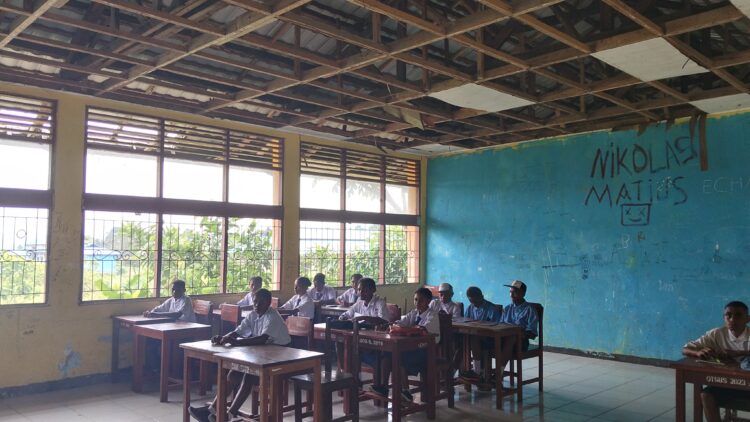
Samuel said the situation was having a significant impact on children’s education and development. He was concerned that Papuan children would continue to fall behind while children in other parts of Indonesia continued to advance and develop.
“How can we produce a workforce that is ready to compete and continue developing if these problems are so difficult to address?” Bayani said.
The problems facing schools in remote villages go beyond a lack of classroom facilities. Bayani said many students also had to walk long distances to attend school because their remote communities were not served by adequate transport.
“The local government appears to be very slow to respond, and it seems as though these problems are being allowed to continue because they are not new,” he said.
Obed Kromsiang, chairman of the Pace Mace Information and Communication Technology Administration (PemanTIK) in Jayapura Regency, said his organisation had also frequently found schools in poor condition because of deteriorating buildings and inadequate supporting facilities.
Kromsiang said that while technology had advanced rapidly, the way education services were used and managed had not kept pace and there was a tendency for people to overlook basic infrastructure.
“Chairs, tables and desks are physical objects made from very strong wood. So the big question is, how can this infrastructure simply be missing from classrooms, with doors and windows coming off?” Kromsiang said.
The situation is particularly ironic given how far education service standards have developed alongside advances in technology. At the national level, school examinations, including the National Examination, are conducted online, with students using computers to complete their tests.
Yet students in Jayapura Regency are still dealing with a lack of basic facilities, including desks, chairs, libraries and laboratory equipment, as well as school buildings that are no longer fit for purpose.
Kromsiang highlighted the contradiction, saying computers and other supporting equipment could hardly be expected to remain secure in schools where buildings had been left exposed.
“In areas on the outskirts of the city, there are many schools where the facilities and infrastructure are in a severely deteriorated condition, and it gives the impression that the local government is simply allowing the situation on the ground to continue,” Kromsiang said.
He said improving school facilities and infrastructure needed to be accompanied by a shared commitment among stakeholders to maintain them.
Kromsiang said schools should not focus solely on delivering the national curriculum and programmes, but should also teach ethics, good manners, customary practices and how to care for public facilities that had been provided.
Where is the Papua’s Special Autonomy funds?
Article 34(3)(e)(2)(a) of Law No. 21 of 2001 on Special Autonomy for Papua, as amended by Law No. 35 of 2008 and Law No. 2 of 2021, states that 30 per cent of Papua’s Special Autonomy funds must be allocated to education spending.
In 2026, the Special Autonomy funding received by the Jayapura Regency Government fell to 164 billion rupiah, down from 217 billion rupiah in 2025.
Under the Special Autonomy law, this would mean at least 55 billion rupiah should be allocated to education. Yet a long queue of damaged schools still awaits repairs.
Yesaya said his school had received almost no Special Autonomy funding specifically for school repairs.
“With BOS funding, we’ve only just proposed it in our budget plan for next year, specifically to purchase chairs and desks. We proposed it previously as well, but operational funding is very limited and not provided regularly. It is only for activities, programmes and the purchase of other supporting facilities, while the physical infrastructure is determined by the Education Office,” Yesaya said.
Muhammad Akbar, chairman of Commission C of the Jayapura Regency Legislative Council, also raised concerns about the condition of several schools across the regency.
He said he felt deeply concerned when he saw students attending lessons while sitting on desks, sharing chairs or even sitting on the floor.
“This situation shows that the local government’s 2025 work report did not achieve 100 per cent, particularly in the education sector,” Akbar said.
He said the problem was not limited to a single school, but affected many schools located far from Sentani, the capital of Jayapura Regency.
“What knowledge can students gain from going to school every day when their classrooms are in that condition? And that’s not even considering the long distances between their homes and schools,” he said.
Akbar acknowledged that education problems in Jayapura Regency extended beyond school facilities and infrastructure.
He said there were also shortages of teachers, along with a lack of basic facilities for teachers, including accommodation, while remuneration for many teachers remained unpaid.
Akbar also said the Jayapura Regency Government did not appear to have up-to-date basic data detailing the number of teachers working at each school, from primary through to senior secondary level.
The number of teachers needed at individual schools was also unclear, he said.
“One or two years ago, we coordinated this through a hearing with the relevant government agencies and asked for all these problems to be inventoried. We also asked the relevant agencies to propose programmes to revitalise or renovate classrooms as part of their departmental programmes.
“There has been a failure to address the situation, because these conditions have existed for a long time. But the current financial situation is also a major factor in determining what can be done,” he said.
Akbar said the Education Office should have a clear strategy for delivering education services through schools at every level.
He said the various problems affecting education services would ultimately have an impact on efforts to improve the quality of education and develop human resources.
At the beginning of 2026, the Jayapura Regency Government launched a programme to revitalise school facilities and infrastructure as part of a programme initiated by the Ministry of National Education.
The revitalisation programme prioritises the renovation and construction of new classrooms, teachers’ and administrative rooms, school toilets, libraries, laboratories and school health units (UKS).
The heart of Papua’s Special Autonomy?
Papuan academic Agus Sumule said the large number of damaged school buildings and schools without basic facilities reflected a worsening education situation in the region.
He called on local governments to address the problem seriously and urgently so it did not further undermine the quality of education.
He said conducting lessons in classrooms with inadequate facilities and infrastructure — including shortages of desks, chairs and benches — could affect not only student attendance but also teachers.
“The situation has a serious impact on people’s mental and psychological wellbeing, both teachers and students,” Agus said in a WhatsApp message on Friday, August 14, 2026.
Agus said education programmes at each school already included budget allocations for maintaining facilities and infrastructure. These plans also involved policies agreed upon by school committees, parents or guardians and schools.
He said School Operational Assistance, known as BOS funding, could also be used to address shortages of desks, tables and chairs in classrooms.
Regarding the allocation of 30 per cent of Papua’s Special Autonomy (Otsus) funds to education, Agus said the allocation was already substantial enough.
He said the funding could be used to provide scholarships specifically for Indigenous Papuans (OAP), as well as to build or rehabilitate schools and classrooms, provide facilities and infrastructure, and support teacher recruitment and welfare.
“Of the total budget, 30 per cent must be used for education spending, in accordance with Government Regulation No. 106 of 2021 on the Authority and Institutional Arrangements for Implementing Papua’s Special Autonomy Policy,” Agus said.
An Indigenous community leader said the poor condition of many public schools in Jayapura Regency reflected what he described as government inaction and a lack of concern from local authorities.
He said Papua’s Special Autonomy had been granted with a mandate to prioritise education and health services across Papua.
Bernadus Iwong, secretary of the Demutru Namblong Customary Council, said Special Autonomy funds intended for Indigenous Papuans should be properly used, particularly to improve education services.
The man commonly known as Nadus proposed involving Indigenous communities as members of school committees at all levels of education so they could help oversee the implementation of education programmes.
According to Nadus, the poor condition of public schools in Jayapura Regency indicated that Special Autonomy funds had not been managed to their full potential to improve the quality of education in Papua.
He noted that Special Autonomy funding had been provided for 25 years, since Papua’s Special Autonomy policy was introduced in 2001.
“We all know what the schools are like. Principals and teachers cannot do much because of the situation and conditions we are facing today,” he said.
Nadus said the condition of many schools in Jayapura Regency was concerning, despite the responsibilities for managing education facilities and infrastructure being clearly assigned to government agencies.
He said local authorities should respond to the poor condition of schools with clear action.
“Once again, Indigenous communities must be involved in delivering education services,” he said.
Nadus also called on all parties to closely examine the actual conditions of schools across Jayapura Regency, saying many school buildings were too old and had deteriorated badly.
He said the worst conditions were generally found in remote areas far from urban centres.
“We talk about developing human resources, and we talk about making use of natural resources. How much of what is required by the rules and the Special Autonomy budget has been implemented?” he said.
Nadus said education services were at the heart of Papua’s Special Autonomy.
“Whether Papua’s Special Autonomy funding is reduced or increased, or the central government cuts its spending, there is no reason not to improve education services in Jayapura Regency. Restore dignified education services for our generation today,” he said. (*)