Jayapura, Jubi – Pembina Papua State Special School (SLB Negeri Pembina Papua) is expanding vocational education for students with disabilities in junior and senior high school, with a focus on preparing them to live independently after graduation.
The school offers a range of vocational programs designed to equip students with practical skills they can use in their future lives.
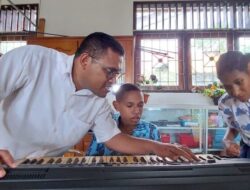
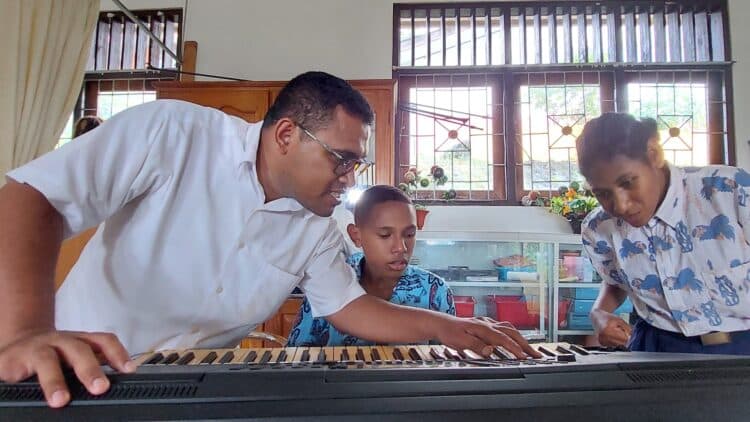
The sound of piano keys broke the morning silence from behind the walls of a room at SLB Negeri Pembina Papua in the Buper Waena area of Jayapura on Wednesday morning (12/8/2026).


The room also serves as a vocational workshop for beauty and salon training. Unlike a conventional classroom, there were no rows of desks. Instead, Edward Fonataba was there with two students, Adriel and Agnes, practising the piano.
The activity was part of the school’s regular vocational workshop classes, which are held twice a week, on Wednesdays and Thursdays. Students are encouraged to develop practical skills that can help prepare them for life after school.
The school provides intensive and regular training in a range of skills, including music, noken-making, batik, woodcraft, cooking, information and communication technology, beauty and personal care, acupressure and souvenir-making.
School staff recognise that focusing solely on academic subjects could make it harder for students to live independently in the community after graduation. The importance of practical skills has also been highlighted by school leaders who observe the students’ learning and development each day.
SLB Negeri Pembina Papua principal Irwanto Pairunan said the school’s teaching approach was structured progressively according to the students’ level of education to ensure their learning needs were properly addressed.
In primary school, teachers focus more heavily on basic theory.
But once students reach junior and senior high school, the emphasis shifts significantly towards vocational education and practical skills.
“For us, vocational classes begin at junior high school. In previous years, it was 60 per cent vocational training and 40 per cent theory. Now it is 70 per cent vocational training and 30 per cent theory,” Irwanto Pairunan said.
Irwanto explained that when students enter junior high school, the school first offers them a range of vocational programs to choose from. This allows students to explore different areas and identify those that best match their interests and abilities.
“To support the vocational learning process, SLB Negeri Pembina Papua is offering seven vocational workshop programs in the 2026/2027 academic year. These include cooking, woodcraft, information and communication technology, beauty and personal care, acupressure, batik-making and souvenir-making,” Irwanto said.
He said the programs were selected through discussions among teachers to ensure they matched each student’s abilities, physical condition and emotional readiness.
A similar vocational approach is also being implemented at SLB Negeri 1 Jayapura.
The school’s deputy principal, Eduard Tampubolon, said the school placed a strong emphasis on practical skills to equip students with abilities beyond the regular curriculum.
“Cooking skills have been taught from junior high school. Meanwhile, clothing and sewing classes are offered to senior high school students in a classroom on the second floor,” Eduard said.
Eduard said teachers also needed to be able to adapt to students’ individual circumstances and moods.
Teaching students with disabilities required considerable patience, he said, because teachers could not expect lessons to follow the standard curriculum used in mainstream schools.
“Everything we teach, whether it’s basic mathematics or simple hand skills, is adapted flexibly to each child’s abilities and comfort level,” he said.
Developing musical skills
Edward Fonataba carefully demonstrated finger positions on the black and white keys of a keyboard to his two students, Adriel and Agnes.
The 32-year-old Jayapura-born teacher has Papuan-Javanese heritage and is himself visually impaired, with low vision.
His two students, who also have visual impairments, listened closely to his instructions. Adriel, sitting at the keyboard, tried to follow the movements of his teacher’s hands, while Agnes stood behind him and hummed along to the notes they were learning.
Fonataba is a former student of SLB Negeri Pembina Papua. He studied there from primary school before going on to study special education at Makassar State University (UNM).
His experience taking part in special-school competitions, including events outside Papua, has become valuable experience as he now dedicates himself to teaching children with disabilities.
“The goal is to help them develop what they want to do, so that when they leave here they don’t feel discouraged. They can make use of the skills they have. They can gain skills at school that will allow them to work outside and earn an income,” he said.
As a teacher working directly with students in the music room, Fonataba described the regular training schedule and the dynamics of teaching children with disabilities.
“Wednesday and Thursday are practical days. On Monday and Tuesday, we focus on classroom learning and regular subjects. Wednesday and Thursday are specifically for skills training,” he said.
He said students were not assigned to vocational programs at random. Their interests were taken into account, while teachers observed how they behaved and interacted within the school environment to identify their abilities.
“When children first arrive, we don’t immediately put them into these classes. We put them in a regular class first and observe them. We ask, ‘What are they interested in?’ If they like singing, for example, or music, then we see that they may be suited to that area. We then guide them towards the skills that match their interests,” he said.
When teaching music to students with no previous experience who are visually impaired, Fonataba said teachers needed to take a patient, step-by-step approach.
This began with helping students understand the shape and layout of the instrument through touch before gradually learning the basic keys.
“To teach them, we first get them used to using their hands. We say, ‘Try feeling the keys’, and ‘This is what the keyboard feels like’. Then we guide them from there,” Fonataba said.
He said his current music class had only two students, Adriel and Agnes.
Adriel is a former student of the primary section at SLB Negeri Pembina Papua and is already familiar with the school’s junior high school environment.
Agnes attended a different special primary school and is still adapting to her new school environment.
A range of vocational programs
Not far from the music workshop where Fonataba teaches, another group of students were busy in a handicrafts workshop.
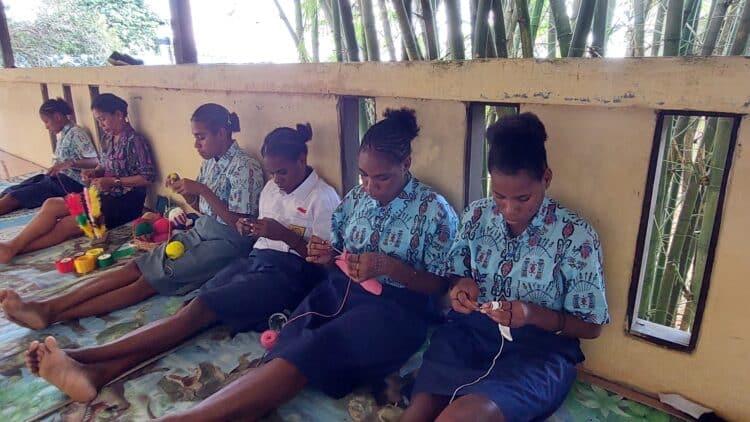
On the veranda outside the room, Selni was helping a group of mostly female students learn to weave woollen yarn and make noken bags.
The middle-aged teacher has worked as a contract teacher at the special school since 2005. She teaches students with a range of disabilities.
“In the skills class, we have students who are deaf, have speech impairments and have intellectual disabilities. When we teach them, some can understand the material and some cannot,” Selni said.
During each lesson, Selni sits alongside her students one by one, teaching them how to weave woollen yarn into noken bags and tablecloths.
“This vocational class is designed to train students to become independent. They can make handicrafts that can later be sold,” she said.
Many of her students’ woven products have already been sold at exhibitions.
“A lot of them have been sold. People often buy them at exhibitions. The children’s handicrafts are regularly displayed at exhibitions,” Selni said.
Students at SLB Negeri Pembina Papua also learn batik-making in a classroom opposite Selni’s workshop.
The batik classes are taught by Sugiharti, a contract teacher who has worked at the school since 2012.
She did not originally have a background in batik-making. However, because SLB Negeri Pembina Papua has a shortage of specialist teachers, she was asked to teach batik as part of the school’s vocational program.
“I didn’t actually have a background in batik-making. But I learned along the way until I was able to do it, and now I teach students to make batik twice a week,” Sugiharti said.
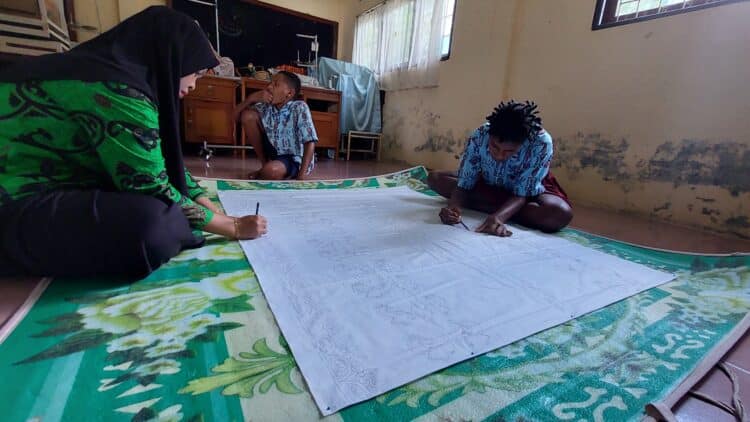
At the batik workshop, Sugiharti works with two senior high school students with hearing impairments from SLB Negeri Pembina Papua. She uses a hands-on teaching approach, demonstrating each step from drawing patterns to using a canting, a traditional tool for applying wax to fabric.
“There are two students in this batik workshop, and both are deaf. I train them slowly, and over time they understand. The important thing is to show them an example. They understand quickly when they can see how it is done. First, we demonstrate it, then they follow,” she said.
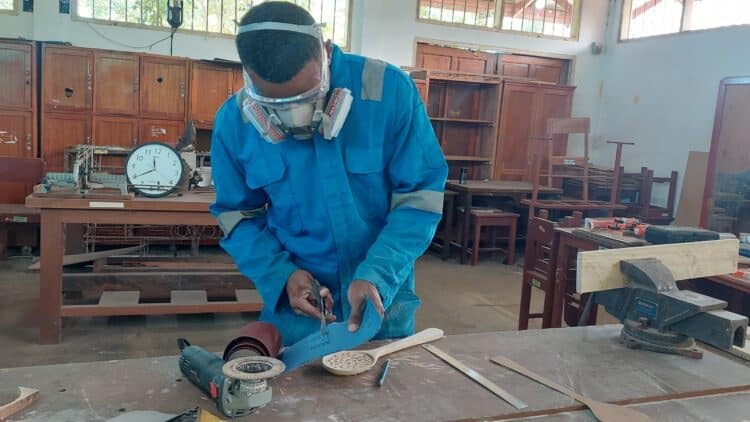
SLB Negeri Pembina Papua also has a woodcraft workshop, where the faint roar of woodworking machinery can be heard.
The vocational woodcraft instructor is Hamsal Lumele, a 46-year-old teacher who has taught woodcraft at the school since 2005.
“I have been at the special school since 2005. I started as a contract teacher and was appointed permanently in 2015. All that time, I have worked in the woodcraft program,” Hamsal said.
At the woodcraft workshop, Hamsal trains students with a range of disabilities, particularly deaf students and those with intellectual or speech disabilities, whom he says often demonstrate strong creativity.
Because Hamsal does not have a background in special education, he has limited knowledge of formal sign language. However, he is still able to communicate with his students using simple practical gestures that they understand.
“In woodcraft, most of the students are deaf or have intellectual disabilities because they learn quickly. The students who learn woodcraft skills fastest are those who are deaf and those with speech impairments but intact hearing. They tend to be more creative,” Hamsal said.
The students at his workshop make a range of household items, particularly kitchen utensils such as ladles, spoons and racks.
“They have made many things, especially kitchen utensils. Some have already been sold. Some of their work has also been entered in national woodcraft competitions for special schools,” he said.
Hamsal said teaching woodcraft skills to students with disabilities required extra patience, as skills often needed to be demonstrated and practised repeatedly until students had mastered them.
He said the school’s curriculum placed greater emphasis on practical skills than academic subjects, with the aim of giving students specific skills they could use to become independent after graduation.
“In the curriculum, about 70 to 75 per cent is devoted to practical skills. At junior high school, it is about 60 per cent, while at senior high school it reaches 75 per cent. Academic subjects account for only 25 per cent,” he said.
Why vocational education matters for students with disabilities
Education for students with disabilities cannot simply follow conventional teaching methods.
Papuan education observer James Modouw said the essence of special education was recognising, nurturing and developing the individual strengths of each child.
“Every physical limitation can come with strengths in other areas. Those strengths need to be identified,” James Modouw said.
He gave the example of children with hearing or speech impairments, who may have particular abilities and strengths in other areas that should be developed.
He said vocational education was important in providing practical skills that matched students’ talents and interests.
Through vocational education, students with disabilities can begin identifying and developing their potential from an early age.
Modouw said universities offering teacher-training and special-education programs also needed to become more adaptable and equip future special-school teachers with specific skills to support their students’ development.
While the expansion of vocational education was moving in the right direction, Modouw said students with disabilities in Papua still faced several barriers to achieving independence.
The biggest challenge, he said, was a lack of facilities and equipment needed to teach the vocational skills offered at SLB Negeri Pembina Papua.
Modouw said teaching aids and learning equipment for students with disabilities often had very different specifications from those used in mainstream schools.
While basic resources such as Braille materials and conventional graphic equipment were relatively accessible in Indonesia, modern vocational equipment was more difficult to obtain.
“Many vocational tools, including electronic equipment for students with disabilities, are not easy to obtain domestically. Usually, these types of equipment have to be ordered from overseas,” he said.
Modouw stressed that students with disabilities had the same constitutional rights as other children, including the right to access appropriate educational facilities.
The importance of vocational skills in helping students with disabilities become independent was also recognised by Pertuni Papua chairman Stefanus Imbiri.
Imbiri, who is visually impaired, attended SLB Bagian A, a special school for blind students in Biak, during the 1970s and 1980s.
Imbiri said students at the school were taught more than just academic subjects. He and his classmates were also trained in a range of life skills, from household tasks to practical skills needed to live independently in the community. During his time at the school, Imbiri learned a variety of skills, including cooking and making woven crafts.
“They trained us in everything — cooking, weaving, whatever it was. There was also a subject called orientation and mobility, which was aimed at helping us become independent,” Stefanus said.
Oryel Kissya, chair of the Jayapura City Disability Community Forum and secretary of Pertuni Papua, said education and vocational training were fundamental to helping students with disabilities become independent.
He said vocational education meant students graduating from special schools should leave with more than just a certificate — they should also have practical skills that could help them find work.
According to Oryel, special schools should provide education that prepares students for the realities of everyday life. Students and graduates should not be left marginalised simply because they lack the skills needed to participate independently in society.
“So when they graduate, what they take with them should not just be a piece of paper. They should have something that benefits them and enables them to receive the rights they deserve,” he said.
Vocational skills developed from an early age are expected to provide a pathway for students with disabilities to become self-reliant, build confidence and live independently after graduation. (*)