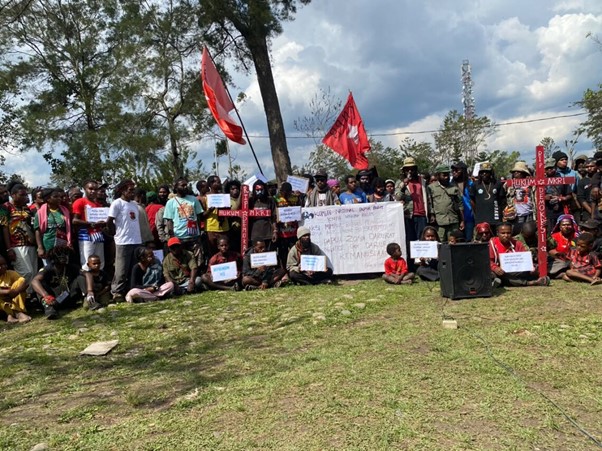
Jayapura, Jubi – The Jayawijaya chapter of the Indonesian National Youth Committee (KNPI), Cipayung youth and community organisations (OKP), and the West Papua National Committee (KNPB) have described the Rome Agreement, signed in Rome, Italy, on 30 September 1962, as an agreement made by what they called “greedy people”.
Jayawijaya KNPI chairman Hengki Hilapok said his organisation, together with Cipayung OKP and KNPB, rejected the Rome Agreement.
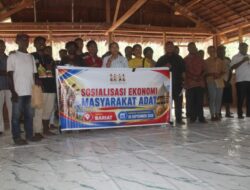
The groups expressed their opposition through a protest held at the KNPB Balim regional secretariat on 30 September 2026, marking the 64th anniversary of the agreement.

“We all reject the Rome Agreement, which was agreed by what we consider to be greedy parties. Unity and solidarity today show that the last line of defence for the Papuan people lies in the movement. Therefore, we will continue to fight for the dignity and rights of Papuan people,” Hilapok said in a video recording after the protest.
Hilapok called on members of the Indonesian House of Representatives (DPR RI) and Regional Representative Council (DPD RI) representing the six provinces in Papua to urge President Prabowo Subianto to allow international journalists and the United Nations High Commissioner for Human Rights to visit Papua.
“When Cipayung youth organisations and Papuan people take to the streets, it means Papua is not in a good situation. Therefore, we ask the international community to come to Papua and investigate alleged human rights abuses in the region,” he said.
He also said the groups rejected a Papua Progressive Youth event, which he claimed was organised by individuals pursuing vested interests.
He said Papuan people were not simply demanding access to food and basic necessities, but were calling for an international dialogue facilitated by a neutral party, rather than by those involved in the conflict.
“We thank the Marshall Islands and Solomon Islands for raising the issue of the Papuan people. We support countries that speak about us as Papuans, because Indonesia is colonising us today,” he said.
KNPB Central Executive Board deputy chairman Warpo Wetipo said the struggle facilitated by KNPB was a peaceful, non-violent movement.
He said the group was demanding justice, truth, honesty, respect for human dignity and freedom.
“We are demanding the restoration of our sovereign rights, which have been taken away and undermined by the ambitions and greed of colonialism, imperialism, American capitalism and its allies,” Wetipo said.
Wetipo said KNPB would continue to facilitate Papuan communities in demanding what it considers to be their rights, which had been taken away by Indonesia.
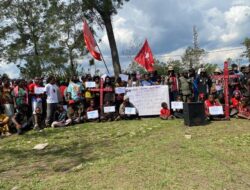
Meanwhile, the Toli regional chapter of KNPB, together with the West Papua People’s Movement (GRPB), the West Papua Liberation People’s Movement (GR-PWB), and thousands of residents of Tolikara, also held a peaceful protest at the Gospel Monument in Karubaga, Tolikara Regency, Highland Papua, on 30 September 2026.
Toli KNPB secretary Lanny Wanimbo, who was responsible for organising the protest, said the Rome Agreement was connected to the 1969 Act of Free Choice.
The group called on the central government to allow Papuans to determine their own political future through a referendum, which it described as the best solution.
“We are holding a peaceful protest to urge Jakarta to open itself up and give us an opportunity for a referendum, so that the conflict in Papua can end,” Wanimbo said.
Protest coordinator Neky Yigibalom said the Rome Agreement did not involve Papuan representatives as parties with rights over the territory covered by the agreement.
He also questioned the implementation of the Act of Free Choice, saying it did not use a one-person, one-vote mechanism.
“We are protesting the Rome Agreement and the New York Agreement because Papuans were not involved as subjects in those agreements,” Yigibalom said.
Yigibalom called on the United States, the Netherlands and the United Nations to take responsibility and review the decision-making processes associated with the two agreements and the Act of Free Choice.
The Rome and New York agreements have been described by the protesters as the basis for Indonesian military operations in Papua from that period to the present, which they say have resulted in human rights violations.
The Rome Agreement was concluded in Rome, Italy, on 30 September 1962, following the New York Agreement signed on 15 August 1962.
The Rome Agreement, signed by Indonesia, the Netherlands and the United States, contained 29 provisions under the framework of the New York Agreement.
Articles 14 to 21 addressed self-determination, which the article says was to be based on international practice, including one person, one vote.
Articles 12 and 13 addressed the transfer of administration from the United Nations Temporary Executive Authority (UNTEA) to Indonesia.
Under the agreement, Indonesia’s claim over Papua was implemented following the transfer of administrative authority over West New Guinea from the Netherlands to Indonesia through UNTEA on 1 May 1963.
However, the Rome and New York agreements were concluded without any representatives of the Papuan people being involved, despite the agreements concerning the future of the Papuan population. (*)