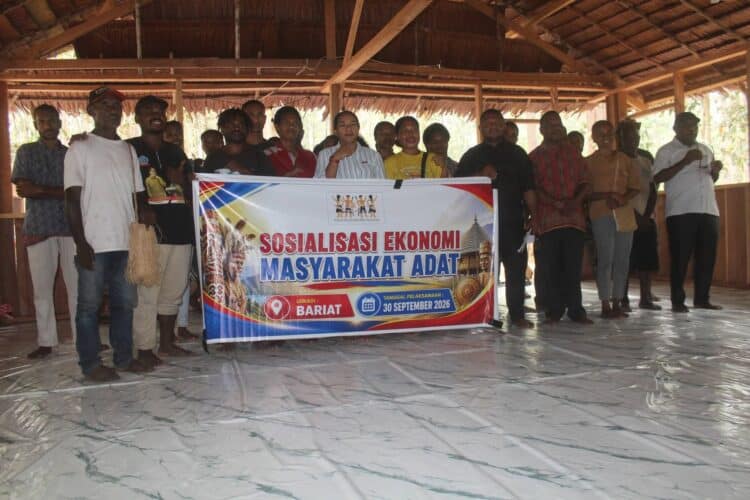
Teminabuan, Jubi – The third regional congress of the Alliance of Indigenous Peoples of the Archipelago (AMAN) Sorong Raya, held over two days on 29–30 September 2026 at the Damar Tourism Forest in Afsyia Customary Forest, Bariat village, Konda District, South Sorong Regency, has elected a new leadership team.
Nabot Sreklefat was officially elected chair of the Executive Board of AMAN Sorong Raya for the organisation’s next term. The congress also appointed several members of the Regional AMAN Council (Damanda) representing customary territories across Sorong Raya.
They are Nataniel Yewen as Damanda representative for Tambrauw, Yulitha Mate for Maybrat, Sara Kristina Elwod for Raja Ampat, and Gamaliel M. Kaliele for Tehit in South Sorong Regency.



Nabot’s election comes with a significant mandate amid a range of challenges facing Indigenous communities, including investment pressures, threats to forests and traditional livelihoods, and the need to strengthen Indigenous organisations down to the clan level.
Nabot said AMAN Sorong Raya must not become merely an administrative organisation, but must serve as a platform for Indigenous people’s struggle.
“AMAN will certainly be at the forefront of resisting anything that threatens Indigenous communities,” Nabot said in an interview on Thursday (1/10/2026).
He said AMAN was established because Indigenous communities faced problems and needed an organisation that would stand alongside them.
“AMAN was born because there were problems. It was established because Indigenous communities needed an organisation that would truly stand behind them and serve as a shield against various threats,” he said.
Nabot also openly criticised investment pressures that he said could threaten Indigenous people’s living spaces.
“We will resist oligarchic investment interests that are now seeking to destroy the living spaces of Indigenous communities,” he said.
Nabot also highlighted the lack of progress in finalising specific legislation on Indigenous peoples. He said legal certainty was an urgent need as pressure on customary territories continued to increase.
“The Indigenous Peoples Bill is an important point for Indigenous communities. Today, the government is passing various laws that have created a dilemma for us as Indigenous people,” he said.
He called on the Indonesian government and House of Representatives (DPR RI) to immediately complete deliberations on the Indigenous Peoples Bill.
National AMAN Council member Sem Ulimpa, who attended the third AMAN Sorong Raya congress, said the forum was part of the consolidation of Indigenous communities across Sorong Raya.
He said participants came from several areas, including Raja Ampat, Maybrat, South Sorong and Tambrauw. Representatives included members of the Maya people from Raja Ampat, the Aifat people from Maybrat, as well as representatives of clans and other Indigenous communities.
“We also provided information about Indigenous community-based economies and leadership training. This is a starting point to help participants understand the context of Indigenous communities, so that going forward we can move forward together,” he said.
Sem said he hoped the congress would be followed by continued efforts to establish and strengthen organisational structures in each regency. He said one of the key tasks for the new leadership would be to document customary territories and the various threats facing Indigenous communities.
The mapping and documentation would help identify areas facing investment pressures and other problems, he said.
Sem said AMAN would support Indigenous communities defending their customary territories.
He said Indigenous communities did not automatically reject all government programs, but that every program should consider the interests and conditions of Indigenous people in the areas where they are implemented.
“We do not reject government programs. But when a government program does not serve our interests, we reject it. We cannot take part,” he said.
He said development must consider the needs of communities at the village and customary territory levels.
“Government programs must not ignore Indigenous communities,” he said. (*)