Teminabuan, Jubi – Indigenous Papuans have their own ways of managing customary forests to ensure they remain protected. They harvest sago for daily consumption and sale at local markets, while also developing ecotourism in their customary territories. Indigenous communities oppose oil palm companies that damage their customary forests.
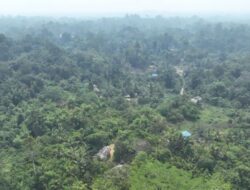
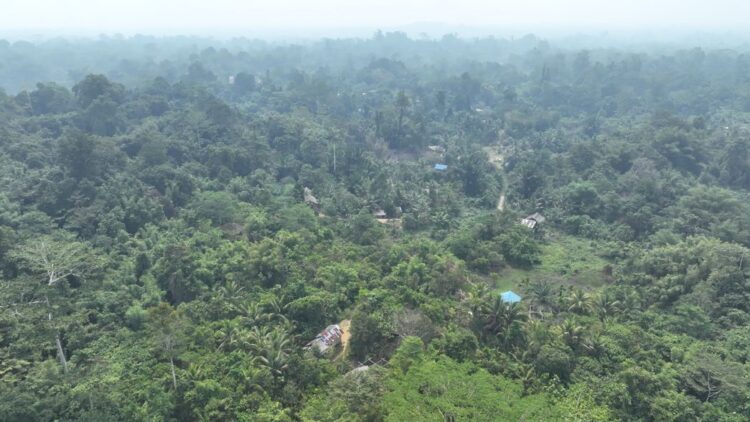
Tall sago palms grow closely together in a forest belonging to the Sesa clan in Komanggaret Village, Saifi District, South Sorong Regency, Southwest Papua. The palms are around five to ten years old. The sago grove can only be reached on foot via a five-kilometre trail through the forest from Komanggaret Village.
Several makeshift shelters and huts built by local residents stand amid the dense sago grove. A traditional sago press made from the base of a sago palm frond is also visible. Piles of pressed sago fibre lie scattered around the area, alongside decaying sago trunks.


At around 6 am on Wednesday, 23 September 2026, Anggria Sesa was seen pressing sago fibre in the grove. Repeatedly, Sesa poured water over the grated sago flesh laid across the base of a sago palm frond. Carrying her 15-month-old child, Virdika Saru, she squeezed the grated sago to extract the starch.
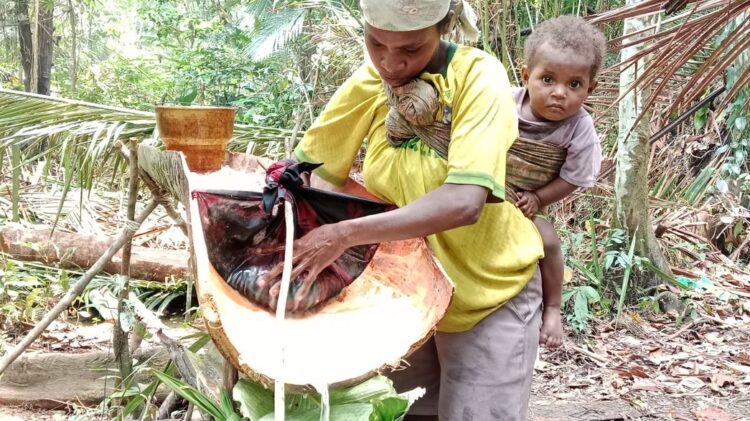
“My father and mother pound the sago. We started at 6 am. We collected two sacks [noken bags] of pounded sago. The tree was felled yesterday. [We can get] five kilograms of sago starch for one family. [If we get] 15 kilograms, that is enough for one to two weeks,” Sesa told Jubi.[helped]
It takes two to four weeks to process the entire sago palm trunk, which measures more than 10 metres long. A single trunk can yield 10 to 15 sacks of sago starch, each equivalent in weight to a 15-kilogram sack of rice.
“If we pound the sago regularly, we can finish in two weeks. If we work more slowly, it takes three to four weeks,” she said.
The Sesa family owns dozens of hectares of sago groves in Komanggaret Village. They have built a simple hut in the grove, supported by four wooden posts, with a roof made of sago leaves and a plank floor. Sesa said she pounds sago once every two months. The starch is then sold at the market in Teminabuan, the capital of South Sorong Regency. A sack of sago starch weighing 15 kilograms, equivalent to a sack of rice, sells for Rp200,000. Sesa earns between Rp500,000 and Rp1 million a month from selling sago starch in Teminabuan.
“Once we finish [processing the sago], we sell it in Teminabuan. We earn Rp500,000 to Rp1 million a month. [The money from selling sago] is used for shopping and feeding the family, and buying rice, salt and seasoning,” she said.
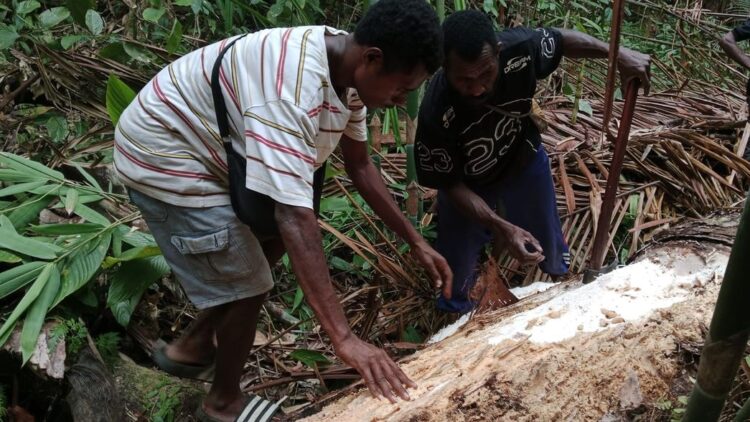
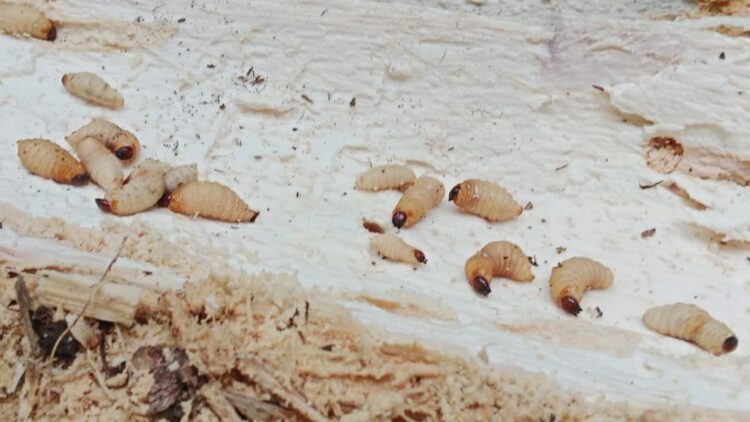
Sesa was not alone in the sago grove. That afternoon, her father, Alex Sesa, 63, joined other men and women in splitting open sago trunks that had been felled two or three months earlier to collect sago grubs. Axes struck the rotting trunks, cutting through and peeling away the decaying bark.
White-bodied grubs with black heads emerged from the decomposing sago trunks. As well as collecting the grubs, the women gathered mushrooms growing on the residue left over from pressing the sago fibre.
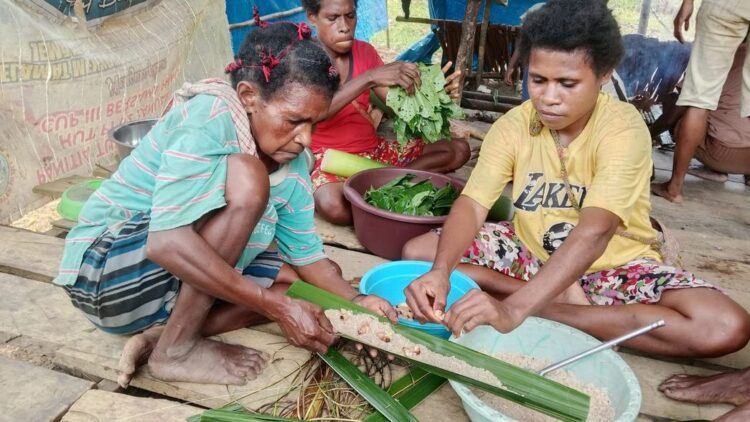
They cooked the sago grubs and mushrooms in the grove. The grubs were mixed with sago starch, wrapped in sago leaves and roasted over a fire. The mushrooms were placed inside bamboo stems and roasted as well. The family and their relatives shared the sago and mushrooms together.
“We wrap the sago [mixed with sago grubs] in leaves and roast it for our meal,” Alex Sesa said.
Mapping the potential
Oktovianus Smori, a resident of Komanggaret Village, and other young people in the village are mapping the area’s natural resources, cultural heritage and handicrafts. Smori said the mapping exercise, which began this year, aims to support plans to develop ecotourism in Komanggaret.
“We are mapping the various potentials [of the village] as part of our plan to develop ecotourism,” Smori told Jubi on Wednesday, 23 September 2026.
The head of the Bonsaris Community said the village’s customary forest remained well preserved. It was home to various bird species, including mata merah and urip birds, as well as other species. The area also had a variety of fruit trees, including langsat, cempedak, rambutan and durian.
The Indigenous community of Komanggaret also has traditional songs and dances, as well as noken bags woven from bark fibre. These cultural traditions and handicrafts could help support ecotourism development in the village.
“After visiting Sorong, our community saw the Malasigi ecotourism site in Sorong Regency. We were amazed by what we saw there. We want to bring [a similar ecotourism development concept] here to develop ecotourism in our village. [We have] langsat, durian, rambutan and cempedak. A single harvest can generate nearly Rp10 million. We sell the fruit in Teminabuan. Durian prices vary from Rp5,000 to Rp20,000 per fruit,” he said.
Smori said the village’s natural and cultural assets could provide a foundation for ecotourism development. He believes ecotourism could improve community welfare while providing a platform to showcase Komanggaret’s cultural heritage and natural wealth.
Smori said developing ecotourism would be preferable to handing over customary forests to oil palm plantation companies. Indigenous communities rejected attempts by oil palm companies to enter the area in 1997 and 2025. He said the companies’ presence would destroy the customary forests on which communities depend for their livelihoods.
“The Knasaimos Indigenous community has agreed to reject oil palm. If an oil palm plantation company comes here, it will harm the community because the forest will be destroyed. In March 2026, I visited SP3 in Sorong and saw how severely the forest had been destroyed by oil palm. Local customary landowners were looking for land to farm. They could no longer build new houses because their territory had been handed over for oil palm plantations. They had lost the places where they obtained food and water. That is worrying, which is why Knasaimos cannot accept oil palm plantations because they will destroy the forest,” he said.
Smori said ecotourism development in the village was scheduled to begin in 2027. The project would cover 1,000 hectares of customary forest belonging to the Smori, Sesa and Samiya clans. Smori has asked the village government to facilitate training in ecotourism management.
“More than 1,000 hectares of customary forest are planned for ecotourism development. We need training to build our capacity to manage ecotourism,” he said.
Exceptional ecotourism potential
Yusdi Nurdin Lamatenggo, head of the Southwest Papua Provincial Tourism and Creative Economy Office, said the province had significant potential for ecotourism development. He cited forest areas in Tambrauw, Sorong and South Sorong regencies as examples.
A 2023 study by Conservation Indonesia and the West Papua Natural Resources Conservation Agency (BBKSDA Papua Barat) found that, of South Sorong Regency’s total area of 654,900 hectares, 497,522 hectares were classified as high-value natural ecosystems. South Sorong has 32 types of natural ecosystems, including tropical peat swamp forests that are essential for climate change mitigation and adaptation.
The study also recorded 416 plant species and 372 vertebrate species, comprising 58 mammals, 280 birds, 36 reptiles and 14 amphibians.
“When we talk about ecotourism, we must first look at the potential. Our natural wealth is extraordinary. We also have invaluable cultural wealth when it comes to ecotourism,” Yusdi said during a parallel session on sustainable ecotourism at the Papeda Summit forum in Sorong, Southwest Papua, on 3 September 2026.
Yusdi said ecotourism development could improve the welfare of Indigenous communities. He cited tourism in Raja Ampat, which he said generated an economic turnover of Rp12 billion annually and attracted at least 12,353 visitors a year.
Yusdi said these benefits could be realised if Indigenous communities were actively involved in ecotourism development. Community participation is essential to the planning and implementation of ecotourism and tourism initiatives.
“Ecotourism succeeds when communities are involved from the planning stage through to the actual activities. Without community involvement, there is no ecotourism. Community participation is essential to ecotourism development. We [the government and its partners] are merely facilitators,” he said.
Yusdi cited the success of the Indigenous community in Malasigi in developing its ecotourism initiative. Previously, the village was known as a place where people hunted birds.
“Over time, people began to understand the importance of ecotourism and received support from partners. Today, they are actively involved in the ecotourism industry. In 2024, Malasigi won first place in the emerging tourism village category. Imagine, a village once known for bird hunting has transformed into the national champion in the emerging tourism village category,” he said.
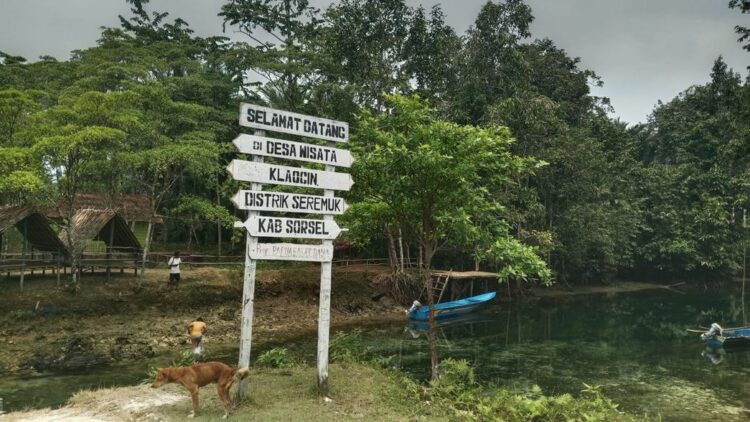
Ica, an ecotourism guide in Klaogin, said ecotourism activities in Klaogin Village, Seremuk District, South Sorong Regency, Southwest Papua, attracted thousands of visitors annually. They came from countries including Canada, the United States, the Democratic Republic of Congo and the Philippines, as well as Jakarta and surrounding communities in South Sorong and Sorong.
“Last year, we recorded up to 2,000 visitors in our guestbook. This year, we have had around 1,000 visitors so far,” Ica told Jubi on Saturday, 26 September 2026.
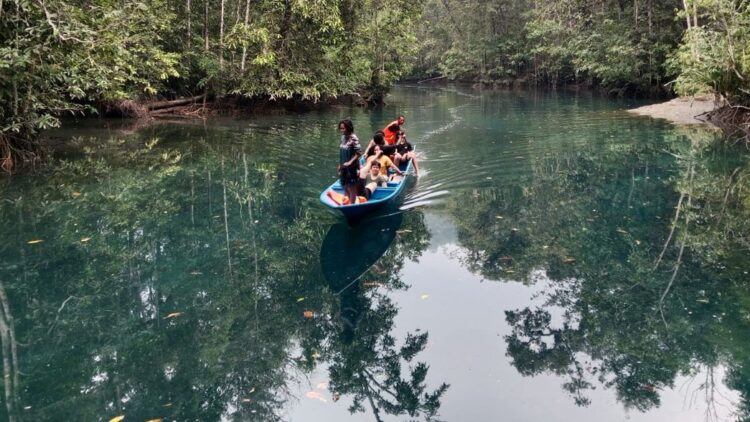
Ica said Klaogin ecotourism was jointly managed by seven clans: the Sawen, Kolin, Yadafat, Momot, Woloin, Ajolo and Wafatolo clans. Ecotourism development in Klaogin, supported by Conservation International, began in 2022.
A study conducted by Conservation International in early 2025 found that the ecosystem around Klaogin Village had high biodiversity, including 41 tree species, 28 bird species and 10 reptile species. The area was also home to nine mammal genera, 13 fish genera and 14 medicinal plant species. Conservation International also identified at least 16 cultural tourism attractions in the area.
Ica said ecotourism packages in Klaogin cost between Rp250,000 and Rp350,000 per person. Visitors wishing to stay overnight could book a homestay for Rp350,000 to Rp750,000 per person per night.
The packages allow visitors to explore the scenic Klaogin River, experience night-time prawn fishing, visit caves and observe a variety of bird species, she said.
Bird species found in the area include the grey-headed goshawk, Pacific baza, laughing kookaburra, sacred kingfisher, little kingfisher, eastern great egret, pied butcherbird, Papuan hornbill, southern cassowary, black-billed cuckoo-shrike, sulphur-crested cockatoo, palm cockatoo, western crowned pigeon, pinon imperial pigeon, orange-bellied fruit dove, wompoo fruit dove, common shining starling and spangled drongo.
Other species include the streaked munia, Papuan pitta, Papuan green-pigeon, northern cassowary, rainbow lorikeet, orange-fronted lorikeet, double-eyed fig parrot, yellow-capped pygmy parrot, dusky lory, red-cheeked parrot, black lory and Moluccan eclectus parrot.
The area is also home to the dusky scrubfowl, Papuan hornbill, Australian koel, little spiderhunter, glossy-mantled manucode, twelve-wired bird-of-paradise, pied cormorant, yellow-faced myna and violet-necked lory.
“There are many more bird species. Visitors are especially happy to see the birds,” she said. (*)