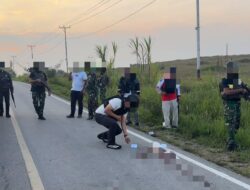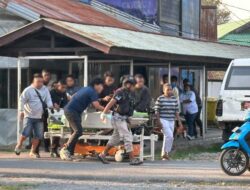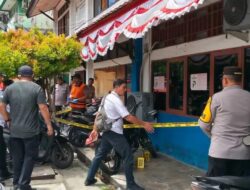

Jayapura, Jubi – The collaborative team behind the documentary Pig Feast – Colonialism in Our Time has distributed Rp517,928,770 (approximately US$31,000) in voluntary ticket contributions collected from audiences as humanitarian assistance for internally displaced people (IDPs) in Papua.
From the outset of the community screening tour, the organisers pledged that all voluntary ticket donations would be used to support Papuans displaced by the ongoing armed conflict.
The beneficiaries are internally displaced communities from areas affected by Indonesian military operations and armed conflict, including Papua Highlands Province, Central Papua Province, and Maybrat Regency in Southwest Papua Province.
After assessing a number of factors, including displaced communities’ access to humanitarian assistance, the Pig Feast organising team decided to distribute the funds across several locations where internally displaced people are living.
Through the Kingmi Church Synod in the Land of Papua, humanitarian assistance in the form of food supplies and cash was delivered to internally displaced communities in Central Papua and Papua Highlands in mid-June.
Aid reached displaced families in Sinak District, Puncak Regency, on June 16, followed by assistance for those sheltering in Sugapa, Intan Jaya Regency, on June 18.
The relief team included Rev. Yahya Lagowan, Rev. Warius Enumbi, Rev. Elianus Tabuni, and a staff member from the Kingmi Synod secretariat.
“These are fellow children of God. The people behind Pig Feast made this film and raised donations for those living in displacement. They could not come themselves, so they asked us to deliver this humanitarian assistance on their behalf,” Lagowan told displaced residents in Sugapa.
Lagowan and his team travelled to Intan Jaya amid deteriorating security conditions. Unmanned aerial vehicles (drones) were reportedly operating over the area, including near the team’s accommodation and around the church where displaced residents were taking shelter. During their visit, an explosive device allegedly dropped from a drone detonated near a group of women washing sweet potatoes, seriously injuring two women.

According to records from the Papua office of Indonesia’s National Human Rights Commission (Komnas HAM), the incident was one of at least six violent episodes recorded in Intan Jaya during May and June 2026.
The continuing military operations and armed conflict across Papua have claimed civilian lives on an almost daily basis, including pregnant women, infants, children, church ministers, teachers, healthcare workers, and pilots.
The violence has also forced increasing numbers of Papuans to flee their homes. According to the Papua Foundation for Justice and Human Integrity (YKKMP), at least 122,932 people have been internally displaced across Papua since 2018. The figure does not include those who have died while living in displacement under increasingly difficult conditions. One of the largest waves of displacement originated in Nduga Regency, Papua Highlands Province.
A second humanitarian team, consisting of Rev. Marthen Keiya, Rev. Nataniel Tabuni, and Rev. Yairus Elopere, distributed aid to displaced families from Nduga at two displacement sites in Wamena—at Ilekma and Kimbim in Jayawijaya Regency—and in Mbua District, Nduga Regency, on June 17 and 18.
The Mbua displacement site is home to residents who fled from the neighbouring districts of Yigi and Mbulmu Yalma.
“We came simply to fulfil what the Pig Feast audiences asked us to do. We did not add anything or take anything away. We delivered exactly what they entrusted to us, and now the assistance has reached you,” Keiya told displaced residents in Mbua.
“Our work at the synod is often accompanied only by tears and prayers. Thanks to this assistance, we could come and visit you. If we had come empty-handed, it would have been even more heartbreaking to face our own people.”
The Pig Feast collaboration team thanked audiences for their solidarity with internally displaced Papuans. While all voluntary ticket donations have now been distributed, the organisers said the humanitarian crisis remains far from over.
They argued that military operations across Papua have expanded to an unprecedented scale alongside the Indonesian government’s National Strategic Projects.
Under the banner of achieving food and energy self-sufficiency, the government plans to convert around 2.5 million hectares of Indigenous land and forests into rice fields, sugarcane plantations for bioethanol, and oil palm plantations for biodiesel. According to the organisers, the projects have been accompanied by the deployment of thousands of military personnel tasked with securing the developments against community opposition.
Despite these pressures, Indigenous communities continue to resist through peaceful actions, including establishing customary blockades, erecting symbolic red crosses, and pursuing legal challenges in court. The organisers said these communities continue to rely on public solidarity.
“There has already been far too much death, suffering, and grief in Papua. This humanitarian tragedy must come to an end,” said Yuliana Lantipo of the Pig Feast – Colonialism in Our Time collaboration team.
“We call on everyone who has supported Pig Feast to join us in urging the Indonesian government to demilitarise Papua, halt extractive projects that dispossess Indigenous peoples of their ancestral lands and destroy forests—including those designated as National Strategic Projects—and pursue an equal and peaceful dialogue between Indonesia and Papua.”
Lagowan said the Indonesian government has a responsibility to protect civilians and pursue a political solution to the conflict, arguing that military operations alone cannot bring lasting peace.
“We Papuans believe the government must seriously re-evaluate its development approach in Papua. Papua’s forests and customary lands are not ownerless. They have belonged to Indigenous communities for generations, with clearly defined customary boundaries inherited by every tribe. There is no empty land here. If the government wants to bring companies into Papua, it must first consult and respect the Indigenous peoples who own these lands,” he said. (*)