Sorong, Jubi – Moi Indigenous youth blocked several government offices in Sorong Regency, Southwest Papua Province, on Monday (14/9/2026), as a form of protest against development and investment policies and National Strategic Projects (PSN) that they say are increasingly threatening the land, forests and livelihoods of the Moi Indigenous community.
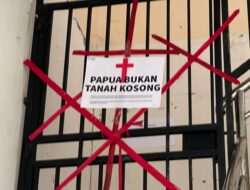
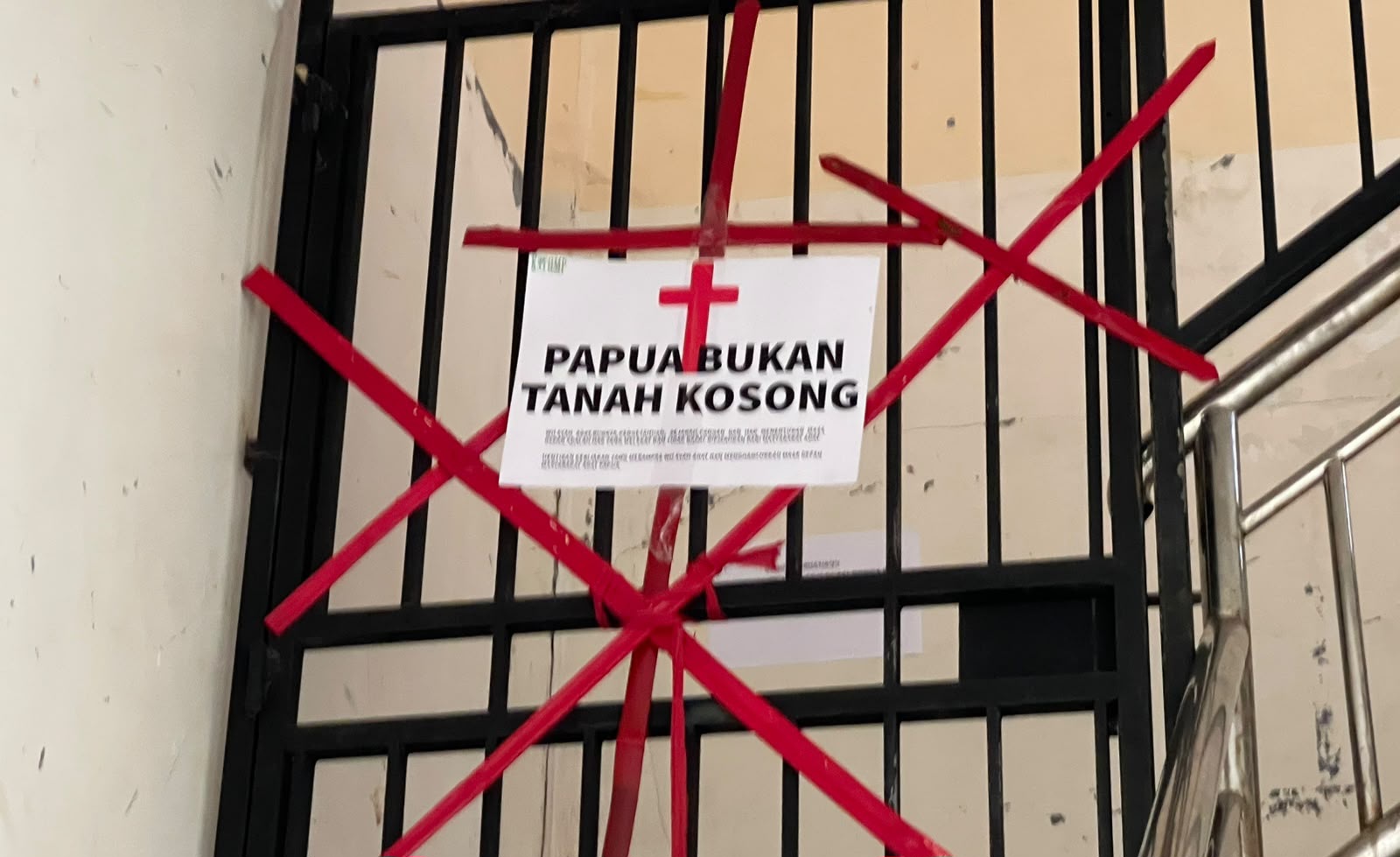
At least seven government offices were blocked by Moi Indigenous youth who are members of the Confederation to Save the Land, Forests and People of Papua (KSTHMP). The blocked offices were marked with red crosses as a symbol of resistance.
The offices included the Sorong Regency Investment and One-Stop Integrated Licensing Agency, the Sorong Regency Land Agency, the Sorong Regency Industry, Trade and Small and Medium Enterprises Agency, the Sorong Regency Agriculture Agency, the Sorong Regency office of the National Land Agency (BPN), the Sorong Regency Public Works and Spatial Planning Agency, and the Southwest Papua Provincial Indigenous Peoples Council (MRP).
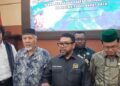

Moi Indigenous youth said that investment had entered their customary territory for decades but had failed to improve the welfare of Indigenous communities. Instead, pressure from land and forest conversion had continued to increase.
“Our enemy is an oppressive system. Our symbol of resistance is the Red Cross. Move now or we will become extinct,” the Moi Indigenous youth said during the protest.
KSTHMP likened PSN projects to vampires that “suck the blood” of Indigenous Papuans, saying large-scale projects could take over land, clear forests, threaten food sources and undermine Indigenous communities’ livelihoods.
KSTHMP said the customary territory of the Moi people covers Sorong City, Sorong Regency, Raja Ampat Regency, parts of South Sorong Regency and parts of Tambrauw Regency.
Protest coordinator Jimmy Nibra said the problems in Papua were not only about development and investment, but also concerned the future of Indigenous communities, who had depended for generations on their customary lands, forests, rivers, traditional gardens and other natural resources.
“This action is a form of resistance against extractive industries that threaten the living spaces of Indigenous Papuans. Land and forests are not merely economic commodities, but part of the life, identity and future of Indigenous communities,” Jimmy Nibra said.
He said the Moi Indigenous community had been exposed to investment since 1935. However, after decades of investment, the community had yet to achieve greater prosperity. Investment had instead left behind agrarian and environmental problems.
“Instead, customary land is under increasing pressure, and the environment is suffering further damage,” he said.
According to Nibra, oil palm plantations have had some of the most damaging impacts on the lives of the Moi Indigenous community.
Oil palm plantations in Sorong Regency include PT Henrison Inti Persada, which is described as a subsidiary of Capitol Group, as well as three subsidiaries of Ciliandry Anky Abadi (CAA): PT Inti Kebun Sejahtera, PT Inti Kebun Sawit and PT Sorong Global Lestari.
“Oil palm plantation companies in Sorong Regency have contributed significantly to deforestation and violated the rights of the Moi Indigenous community,” he said.
KSTHMP also urged the Sorong Regency Government not to issue any documents that could legitimise the activities of three oil palm companies until Indigenous rights issues had been resolved.
The three companies are PT Papua Agri Mandiri (PAM), PT Sorong Agro Sawitindo (SAS) and PT Papua Lestari Abadi (PLA).
Nibra said the central issue was how the state could ensure that development and investment policies did not come at the expense of Indigenous peoples’ rights.
“Customary land must not be treated as if it were empty land. It contains history, ancestors, life, food sources and the future of the next generation,” he said.
KSTHMP representative Ronal Timle also raised concerns about a government program to establish around 12,000 hectares of rice fields in Sorong Regency. He said the program could potentially alter the traditional food system of the Moi Indigenous community.
“We view the rice-field development program as a form of gastro-colonialism, or colonisation through food. When local food systems are forcibly replaced by food models brought from outside, what is threatened is not only the land but also the food sovereignty of Indigenous communities,” Ronal Timle said.
He said the Moi Indigenous community already had its own food system, which had developed through its relationship with forests, gardens, rivers and the surrounding environment.
Therefore, the rice-field development program did not provide sufficient space for Indigenous communities to determine for themselves how they should manage their territory and food sources.
“Food security must not be used as a justification for destroying local food systems. Communities could lose the food sources that have enabled them to survive,” he said.
According to Timle, the PSN program in Merauke Regency, South Papua Province, showed that customary land was in an extremely vulnerable position.
When large-scale projects entered an area, Indigenous communities often became the weakest party in determining the future of their own land.
Timle said there was a fundamental difference between the way corporations and Indigenous communities viewed land and forests. Corporations viewed natural resources in terms of profit.
For Indigenous communities, however, forests are life, land is identity, rivers are sources of life, and the entire customary territory is connected to the history of their ancestors.
“Extractive industries in Papua have become a serious threat to Indigenous communities who have long depended on forests and natural resources for their livelihoods,” he said.
As a result, development was seen as measuring success primarily through investment value and economic growth while overlooking the social and ecological costs borne by Indigenous communities.
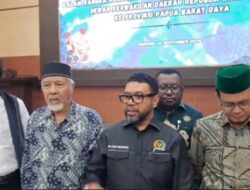
During the protest, KSTHMP presented nine demands to the Sorong Regency Government and other relevant parties.
Among other demands, they urged the Sorong Regency Government to accelerate the recognition of customary territories and called on the Sorong regent to establish a monitoring and evaluation team for oil palm plantation permits.
They also called on the Sorong Regency Government to halt all processes that could legitimise the activities of PT Papua Agri Mandiri, PT Sorong Agro Sawitindo and PT Papua Lestari Abadi.
They rejected the activities of the Task Force for the Enforcement of Forest Areas in the Malamoi customary territory. They also rejected the PSN in Merauke and throughout Papua.
They expressed support for the struggles of Indigenous communities in Papua and Indonesia to defend their customary lands and forests against various attempts to take them over for what they said were investment interests.
They rejected the establishment of the Sorong Special Economic Zone (SEZ) and urged the government to immediately halt plans to clear 98,824.97 hectares of customary forest for PSN-related interests in Southwest Papua.
They also called on the government to halt plans to clear the 98,824.97 hectares of customary forest, urged regional governments to accelerate recognition of customary territories, and called on the state to immediately pass the Indigenous Peoples Bill into law.
They rejected the government’s Red-and-White Cooperative program if its implementation did not involve Indigenous communities and obtain their free consent. (*)