
Jayapura, Jubi – Siti Mnuari felt how the ecosystem of Wondama Bay has changed. She remembered the time when oci fish or yellowstripe scad (Selaroides leptolepis) was abundant in her village in the 1980s. However, since the 1990s, it became harder to find oci in Sombokoro Village, Windesi District, Wondama Bay Regency, West Papua Province.
She remembered the times when oci fish was plentiful up to the beach. Oci were scattered all over the beaches to avoid predators like Papuan seerfish (Papuan spanish mackerel) and other bigger fishes. In the beach, the villagers would scoop the fish without much effort.
“We catch oci fish, and put them in a bucket or a container. At that time, fish were abundant and plentiful,” said Siti when telling her story in the Sombokoro Village Office.

In the 2000s, almost no groups of oci swam along the coast of Sombokoro Village. Siti and the villagers of Sombokoro noticed that their coastal area had changed.
The same happened in Aisandami Village in Duari Bay District, Wondama Bay Regency. An Indigenous elder of Aisandami Village, Octovianus Bosayor, mentioned that it is harder to find oci.
“In the language of Aisandami Village and the Islands of Roon, we call them (fish) inggur,” said Bosayor.

The destruction of the marine ecosystem has caused a decrease in fish population in many territories in West Papua Province. The Regional Secretary of West Papua Province, Ali Baham Temongmere stated that the current challenge of marine resource management is the increasing demand from people’s daily needs. This leads people to take from the sea using methods that are not eco-friendly.
“One of the stories, in Bakaro Beach Manokwari, where there was a villager who could call fish with a whistle, so that fish would come when the tide was low in the mornings or evenings. Fish would come quickly, and people would feed them termite nests and ant nests,” said Temongmere in Manokwari, the capital city of West Papua Province.
For instance, Temongmere and some West Papuan Provincial Governement officials came and witnessed the tradition of fish calling in Bakaro Beach. Unfortunately, there were no more fish that came up to eat the termite nests.
“While being furious, the fish whistler said that that is because [people] catch fish using explosives, hence fish die and never return,” he said.
Indigenous community-based
The changes in the marine ecosystem made the Indigenous Peoples of Wondama Bay realize that they must revitalize the tradition of closing the coastal area to catchment activities for a certain period of time that is required for the restoration of their marine ecosystem and biodiversity in the coastal area.
These similarities of Indigenous People’s views serve as social capital in upholding values and norms that are materialized by the government (authorities) in forming references or guidelines regarding marine conservation zones
Korneles Mnuari, an indigenous elder of Sombokoro village explained that sasi is a term originating from Maluku Province.
“Sasi itself actually orginates from the Maluku language, on Saparua Island. [Sasi is] a tradition of protecting the sea by prohibiting [catching] from a certain period of time, and then is open back [for] the people to [fish] based on [their own] needs,” Mnuari.
Each territory in West Papua has their own term for sasi. In the Fakfak regency for example, sasi is known as kera-kera. The indigenous Peoples of Sombokoro village called sasi with the term sawora
In Aisandami and Menarbu Village, the tradition of sasi is called kadup, which means pele or blocking. Meaning, if an area is closed for the implementation of kadup, then people are banned for catching seafood there for a certain period that was agreed together. The villagers of Sombokoro call this closing zone as sawora.

The implemetation of sasi / kadup / sawora is similar to the arrangement of conservation zones by governments. The difference is that the conservation zone by the government is permanent, while the establishment of sasi, kadup, and sawora is time-based and agreed upon by Indigenous Peoples. Mnuari explained, when sasi/kadup/sawora is open, Indigenous Peoples will harvest abundantly.
Some environmental non-government organizations are making an effort to revive and relive the tradition of kadup and sawora in Wondama Bay Regency. For example, World Wildlife Fund (WWF) Papua has accompanied the villagers of Sombokoro and Yop Meos in Windesi District, as well as the villagers of Menarbu in the District Islands of Roon and Aisandami in Douari Bay District.
Community-Based Conservation and Indigenous and Community Conserved Areas) WWF Indonesia Program Papua, Feronika Manohas called the tradition of kadup and sawora which closes the zone for an agreed period of time, not only for the marine or coastal areas. The Indigenous Peoples in Sombokoro village initially only implemented sasi on land, for the protection of their Indigenous forest.
“In Sombokoro, [sasi] is called sawora or pele, [meaning] an oath of prohibited area. They apply restrictions in the forest by protecting the place with [using] red cloth as a prohibition sign [for] others to take betel nut, coconut, garden [produce], and protected plants. [The prohibition is in effect] until the time when sawora will be opened,” she said.
She explained that kadup and sawora are part of the indigenous cultural heritage in that region that emphasizes prohibitions regarding overharvesting.
“For example, in Menarbu Village, there is a custom that catching ikan julung (Hemiramphus lutkei) is only for men, and they must catch it using traditional gear/tools. Indigenous Peoples already have rules regarding marine resource management,” she added.
Kadup is referred to as a form of community-based resource management. This management of resources aligns with Article 6 No. 2 of Law No. 31 of 2004, which states, “The management of fisheries for the importance of fish catchment and cultivation must take into consideration the customs and/or local wisdom, as well as the participation of the people.”

The National Park Area III Management Section in Aisandami noted that kadup implemented along the coasts of Menarbu Village lasted for two to three years. A Sasi, which started in 2018, was opened in March 2020. The coastal area of Kampung Menarbu was then closed again in May 2020.
According to the National Park Area III Management Section in Aisandami staff , Rusthesa Laitrani, the traditional village communities of Menarbu do not work alone in implementing kadup. They are supported by the Menarbu village government, the church, and other Indigenous leaders.
“The marine management that they carry out is based on local values, and even their harvest is used responsibly,” she said.
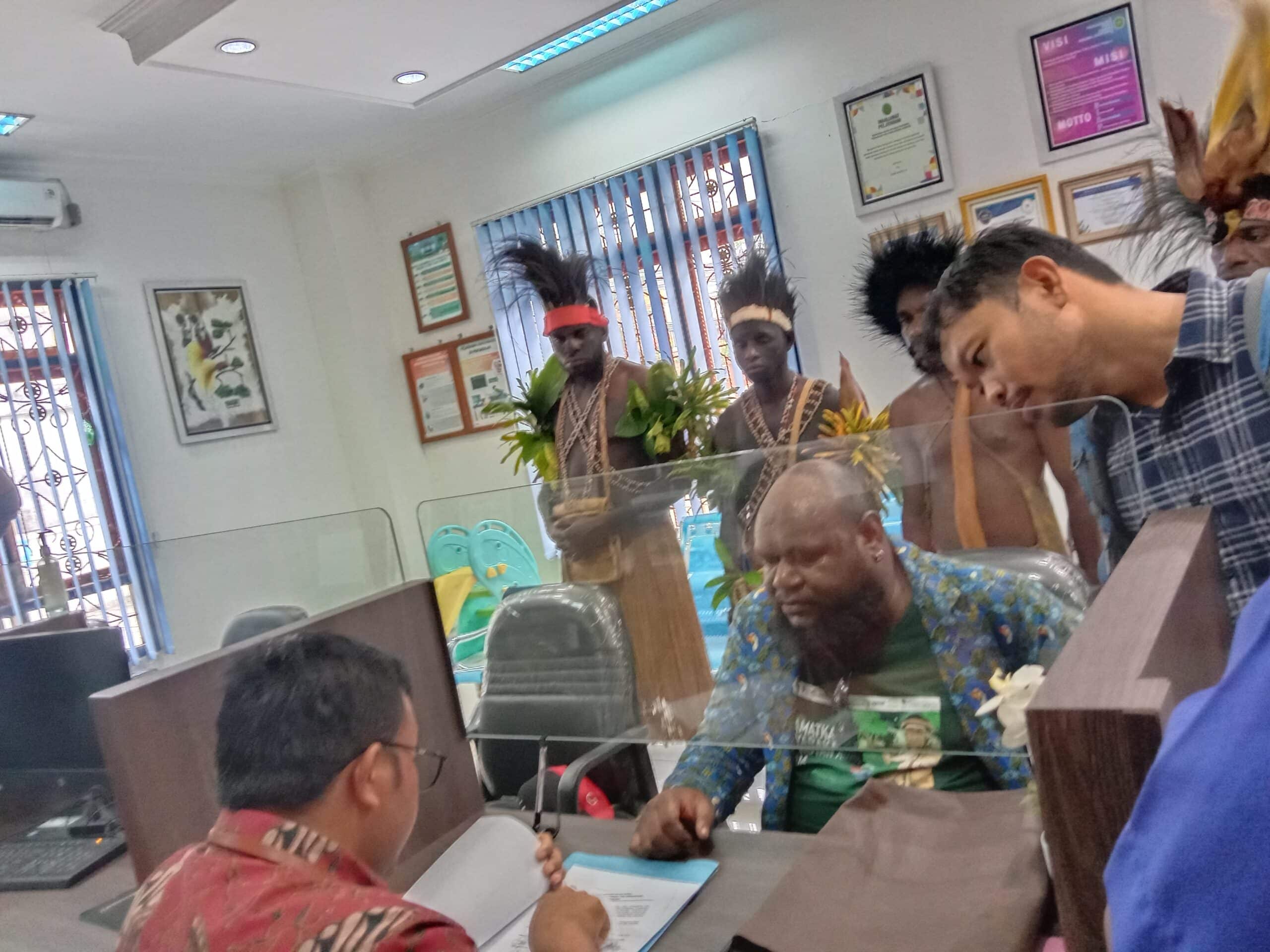
Similar initiatives have also been carried out a few times along the coast of Aisandami Village. For example, on December 5, 2024, Bosayor led a traditional ritual to open kadup on the Aisandami coast, after the area had been closed using kadup for three years..
The head of Sombokoro Village, Ismail Mnuari, stated that the village government, along with elders and church leaders, implemented sawora on their village’s coasts from 2015 to May 2018. While sawora was in effect, the villagers of Sombokoro and others were not allowed to catch anything from that sawora area.
He still remembers how his people really missed harvesting seafood from that location and welcomed the opening ceremony of sawora with happiness.
“That is one of the ways to protect the aquatic ecosystem and prohibit people from catching fish and other habitats in the area for a certain period of time,” said Ismail.
Upholding Indigenous norms
As a prohibited sign, the effectiveness of kadup and sawora is based on the respect for the indigenous culture of the people. Dr. Hugo Warami from Universitas Negeri Papua in Manokwari explained why kadup and sawora, as customs, are obeyed by the Indigenous Peoples in that area.
Dr. Warami said that Saireri Territory is part of Wondama Bay and is located within the Cendrawasih Bay Marine National Park (TNTC). Based on the socio-economic factors, Indigenous Peoples in the region are divided into two major groups: coastal communities and inland communities of the lowlands of Cendrawasih Bay.
“The main sources of income for coastal communities are derived from the sea, gardening, and foraging. Their existence as coastal communities has given them a long history of interaction with non-Papuan communities,” Dr. Warami said.

On the other hand, the inland communities are not accustomed to interacting with outsiders and may be suspicious of newcomers. Their primary sources of income come from foraging in the surrounding environment in the lowlands, such as sago, gardening, and fishing in the rivers. They also hold strongly to tradition and indigenous law.
Dr. Warami also explains that the Indigenous Peoples inhabiting Wondama Bay Regency share similar views, authority, and allegiance among their communities. Warami believes that these similarities serve as social capital in upholding values and norms that are materialized by the government (authorities) in forming references or guidelines regarding marine conservation zones. This explains why Indigenous Peoples comply with the implementation of kadup and sawora in specific areas.
He also mentioned totemism—in which each clan (family name) gives respect to certain flora and fauna that are believed to be important parts of their identity and existence—serving as a guiding principle in natural resource management.
“For example, certain clans avoid or prohibit eating the meat of dugongs and stingrays to prevent pest attacks. This results in an ideology among Indigenous Peoples regarding the cosmos, which becomes part of their livelihood,” he said.
Totemism leads each clan or family name to view everything as more than mere physical entities. Everything in nature, including flora and fauna, is believed to possess powers beyond what is visible (supernatural).
The difference is that the conservation zone by the government is permanent, while the establishment of sasi, kadup, and sawora is time-based and agreed upon by Indigenous Peoples
This explains why there are many “sacred places” in the surroundings of the Indigenous Peoples of Wondama Bay where they live. For example, Tanjung Ayami is believed to be sacred and, therefore, is not used for any social or economic benefits. The belief in sacred places is a tradition that has been passed down from generation to generation and serves as a norm in regulating people’s behavior when interacting with nature, including the marine ecosystem.
Bosayor who has twice led the ritual of closing and opening kadup in Aisandami Village stated that sacred places, or forbidden places are referred to as faknik. Areas designated as faknik often have environmental functions that are important for the preservation of the ecosystem, such as fish spawning grounds (where fish lay their eggs).
He mentioned that faknik is one of the ways to protect locations that are considered sacred or forbidden.
“There are certain places that are restricted or regarded as taboo, so the people do not dare to fish in that area. Not only fishing, but even talking or whispering around the taboo sea [for Indigenous People] they do not dare,” he said.
He stated that Indigenous Peoples, by tradition, are aware of the zones and the management of areas that are used differently. Part of the area management involves selecting specific locations for catching seafood and choosing areas that will be closed to seafood-catching activities.
He provided an example of certain locations that are believed to be taboo and sacred, which cannot be entered by clan or family members, nor by people outside the clan.
“In Dusner, there’s a taboo location that cannot be used; no one can take anything from the marine environment there. In that sacred or taboo location, there are plenty of marine species,” he said.

The obedience of the Indigenous Peoples to refrain from entering or taking marine species from the sacred location, even when the marine species are abundant, illustrates how Indigenous Peoples uphold kadup and sawora, which restricts access to other zones for specific periods.
“Therefore, the rules of sasi are highly followed. Once the reverent prayers are made, everyone obeys and fears,” said Bosayor.
Preserving and healing
The benefits of kadup and sawora can be felt by the Indigenous Peoples in Wondama Bay. Bosayor stated that the effects of kadup are highly noticeable. Now, in Duairi Bay, tuna and mackerel are often seen, and sometimes dolphins play around the waters of Duairi Bay.
“We usually see fish entering Duari Bay, and that is because of the kadup that the people follow during the period of sasi or kadup closure,” said Ismail.
Kadup or sawora is also practiced in Yop Meos Village, Windesi District, and in Menarbu Village in Pulau Roon District. The implementation of kadup or sawora in various territories has proven to result in abundant seafood harvests when kadup or sawora is opened. It is not surprising that the villagers of Sombokoro, Menarbu, Yop Meos, and Aisandami have recognized the benefits of implementing sawora or kadup in restoring their water ecosystems.
Many successful practices and benefits from conducting sasi have proven that the people who implement it will reap worthy catches, fulfilling their daily needs and supporting their children’s education. The implementation of sawora or kadup not only has conservation value but also contributes to cultural preservation, blending tradition with traditional conservation practices. (*)