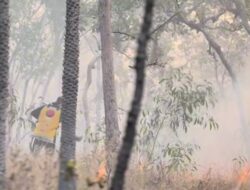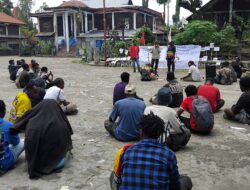
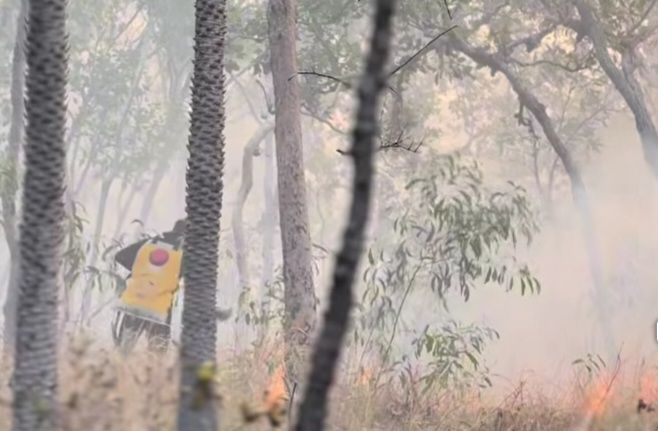
Jayapura, Jubi – The Indonesian Forum for the Environment (WALHI) Papua says forest and land fires in South Papua province have also affected Wasur National Park in Merauke regency, one of the region’s last remaining conservation strongholds.
WALHI Papua executive director Maikel Primus Peuki said the 431,425.12-hectare national park was among the areas affected by fires during the 2026 El Niño-related dry season.
“Based on our monitoring and statements from the Jayapura Region V Meteorology, Climatology, and Geophysics Agency (BMKG), South Papua has experienced a surge in forest and land fires, with a total of 573 hotspots detected,” Peuki said during a discussion on environmental issues and forest degradation in South Papua at Jubi’s newsroom on Tuesday (13/10/2026).


He said Wasur National Park was a vital conservation area and protected a source of drinking water at Rawa Biru in Merauke. However, he warned that the area would face increasing threats if it was not properly protected and maintained.
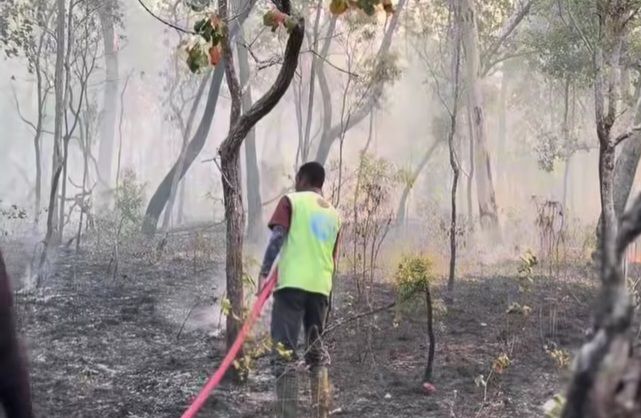
“The Trans-Papua road to Boven Digoel regency runs through Wasur National Park. We conducted an investigation yesterday and found that the park had experienced fires,” he said.
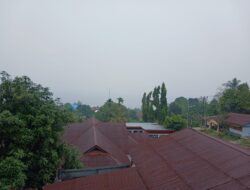
Peuki said Wasur National Park was also among the sources of smoke affecting South Papua. At least 133 hotspots were recorded in the park, while another 71 were detected in Pulau Dolok Wildlife Reserve.
The Pulau Dolok Wildlife Reserve covers 664,627.97 hectares on Dolok Island in Kimaam district, Merauke Regency, South Papua.
A further 294 smoke sources were detected within a forest-area use approval zone managed by the Ministry of Defence, near the 135-kilometre road connecting Wanam and Muting, he said.
Dr. Ignasius Ngari, OFM, a lecturer in artificial intelligence and environmental studies at Fajar Timur Catholic University in Jayapura, expressed similar concerns.
“Wasur National Park should be protected. However, some time ago, the Forestry Department granted the Ministry of Defence permission to clear land for a development battalion headquarters along the 135-kilometre road from Wanam to Muting. This area is also close to Wasur National Park,” Ngari said.
The Ministry of Forestry previously issued a Forest Area Use Approval (PPKH) covering 961.33 hectares for the construction of territorial development infantry battalion bases in several regions, including Papua.
In Merauke, these units have been deployed to support national strategic projects involving large-scale rice cultivation and sugarcane plantation.
The units include Infantry Battalion 802/Wimane Mambe Jaya, whose headquarters is in the Keco area of Merauke.
The location lies along Merauke’s main land corridor, near an access route bordering the outer area of Wasur National Park.
Infantry Battalion 817/AOBA is being established in Jagebob district, in the north of Merauke, near the remaining expanse of Agodai Forest, which is customary land belonging to the Kwipalo clan.
Infantry Battalion 861/Maleo Kamur is based in Wanam village, Ilwayab district, and is intended to support food protection projects in north-western Merauke.
The Pusaka Bentala Rakyat Foundation and WALHI Papua have raised concerns that land clearing for the development areas often proceeds without the consent of customary landowners or overlaps with vulnerable forest areas.
However, the Wasur National Park Office (BTNW) has maintained that food production, road and settlement projects in the Sota and Yanggandur areas are located within Other Land Use Areas (APL) and do not fall within the boundaries of the park’s core conservation zone.
According to information published on the Ministry of Forestry’s website, the Wasur area was initially designated a nature reserve under Agriculture Ministerial Decree No. 252/Kpts/Um/5/1978, dated 2 May 1978. It comprised two conservation areas: the Wasur Wildlife Reserve and the Rawa Biru Nature Reserve.
The Wasur Wildlife Reserve was established to protect wildlife, while the Rawa Biru Nature Reserve was intended to safeguard the drinking water source for Merauke residents.
The two areas initially covered 206,000 hectares and 4,000 hectares respectively. A further 15,000 hectares was later proposed for inclusion, bringing the proposed total area to 225,000 hectares.
The expansion was proposed by the governor of Irian Jaya province through letter No. 1125/DJ/I/1898, dated 10 March 1981. The following year, under Agriculture Ministerial Decree No. 15/Kpts/Um/5/1982, dated 4 January 1982, the area was expanded by a further 98,000 hectares, bringing the total to 323,000 hectares.
On 6 March 1990, the area was declared Wasur National Park, covering 308,000 hectares, under Forestry Ministerial Decree No. 448/Menhut-VI/1990.
In May 1997, Wasur National Park in Merauke regency, now part of South Papua province, was designated as a national park covering 413,810 hectares under Forestry Ministerial Decree No. SK.2549/Menhut-VII/KUH/2014.
About 70 per cent of the park consists of savanna grassland. The remaining area comprises swamp forest, monsoon forests, coastal forest, bamboo forest, sago forest and eucalyptus trees, known locally among the Marind people as bush or minyak kayu putih trees.
Rawa Biru village is located within the park area, administratively part of Sota district in Merauke regency, South Papua.
The village is also home to Lake Rawa Biru, a water source used by the Merauke regional government to supply clean water through the local regional drinking water company (PDAM) for the daily needs of Merauke city residents.
The village is predominantly inhabited by the Kanume subgroup of the Marind people, including the Ndimar, Sanggra, Mayuwa, and Mbanggu clans.
Residents of Rawa Biru also maintain a traditional sasi practice, known in the Kanume language as misar. Under this customary system, members of the Sanggra and Mayua clans prohibit residents and outsiders from hunting wildlife, collecting bird eggs, cutting down trees and catching fish in Lake Rawa Biru.
Men in the village traditionally hunt and farm. Animals hunted include saham (the local term for kangaroos), deer, pigs and cassowaries.
Deer are not native to Merauke. According to Professor Ronald Petocz, the animals were introduced by the Dutch in 1928, after which the population of Timor deer (Cervus timorensis) grew.
The deer population is now reportedly under threat, with many animals crossing into Papua New Guinea, where the Trans-Fly region remains relatively protected and its natural environment better preserved.
Amid differing views over development, WALHI Papua executive director Maikel Primus Peuki has urged people to consider the distinction between developing Papua and development in Papua.
He warned that the latter approach could sideline Indigenous Papuans while prioritising the exploitation of the natural resources beneath their land.
The ecological impacts, including fires and the growing number of hotspots in Wasur National Park, are signs that the environment is under increasing pressure, he said.
“This is not the apocalypse, but we ourselves are turning it into the end of life on Earth. When we talk about the environment, we must also talk about justice and conservation,” Peuki said during a discussion on Jubi TV’s podcast on Tuesday (13/10/2026). (*)