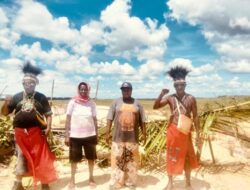
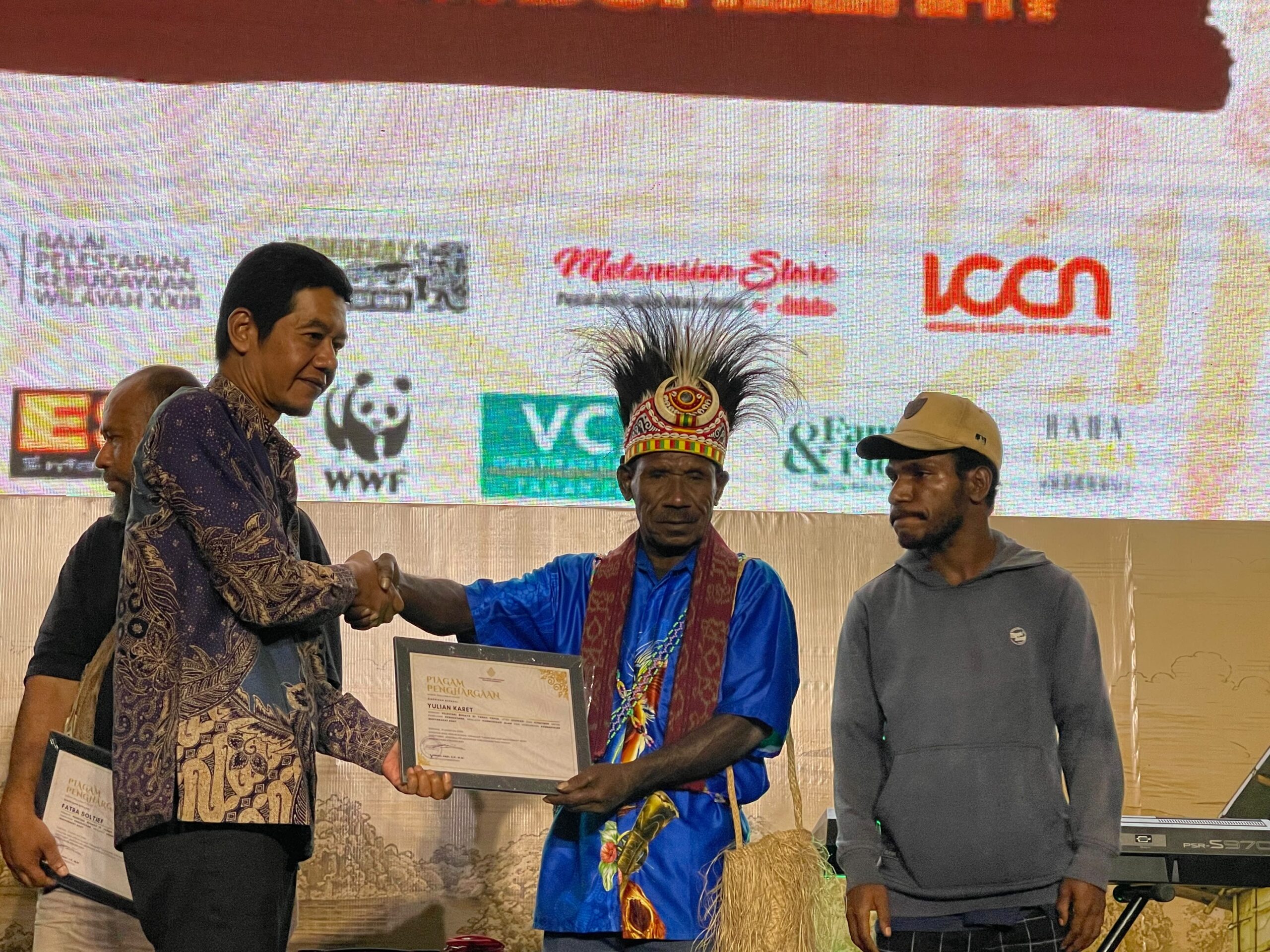
Sorong, Jubi – Yulian Karet, who has spent years protecting the Afsyia customary forest in South Sorong Regency, Southwest Papua, has received an award from Indonesia’s Ministry of Culture recognizing his work as a guardian of customary forests.
The award was presented during the main event of the Domberay Indigenous Youth Jamboree in Sorong City on Tuesday (August 11, 2026).
The certificate, numbered 250/L2/KB.07.11/2026, was signed by Sjamsul Hadi, Director of Belief in God Almighty and Indigenous Communities at the Ministry of
Culture’s Directorate General of Cultural and Traditional Protection.

The ministry recognized Karet as a cultural conservationist in Tanah Papua for his dedication to advancing culture, maintaining harmony between communities and nature, and strengthening the self-reliance of Indigenous communities.
Karet said protecting customary land, forests and Indigenous communities’ living spaces was more than social work. He described it as an integral part of the struggle to preserve Papuan culture.
He said the award should not be viewed as a personal achievement, but as recognition of Indigenous communities that have long worked to protect their customary forests and lands from various threats.
“I do not see this award as being only for me. It is an award for Indigenous communities who have protected the forests, the land and life itself. We protect the customary forest because that is where our lives are,” Karet said on Wednesday (August 12, 2026).
Karet said Indigenous communities could not be separated from the forest, which provides food and traditional medicines and serves as a source of livelihood. The forest also carries historical and cultural ties that are central to Indigenous identity.
He urged the South Sorong Regency Government not to treat oil palm investment as a shortcut to economic development, arguing that plantation expansion threatens customary forests and Indigenous territories.
“The South Sorong government must stop accepting oil palm investment. We are the best guardians of our customary forests. We protect the forest not for our own interests, but for the present and future generations. The forests we protect must not be handed over to oil palm companies,” he said.
Karet said the award from the Ministry of Culture should serve as a reminder to local governments that communities protecting forests for decades need meaningful protection, rather than recognition limited to awards and ceremonies.
“We cannot be recognized on the one hand as cultural custodians while, on the other, our customary forests are opened up for investment that could destroy our communities’ way of life,” he said.
He said development should not come at the expense of Indigenous people’s land, forests, food sources and cultural identity. Karet stressed that Indigenous communities were not opposed to development, but said development should not involve taking customary land or destroying forests.
He questioned who development was ultimately intended to benefit if it resulted in Indigenous communities losing their land, forests, food sources and identity. He therefore called on the South Sorong government to make the protection of customary territories a priority.
Indigenous communities that have protected forests for decades, he said, should not be treated merely as those who bear the consequences of development decisions.
Karet said the award would motivate him to continue protecting the Afsyia customary forest. For him, the recognition also carries a greater responsibility to ensure the forest remains intact and can be passed on to future generations.
“We will continue protecting our customary forest, because if the forest disappears, the culture will disappear too. If the land is lost, the identity of Indigenous communities will also be lost,” Karet said. (*)
Author

About The Author