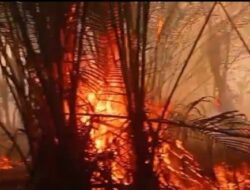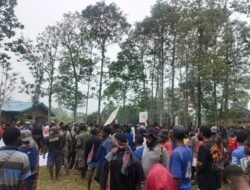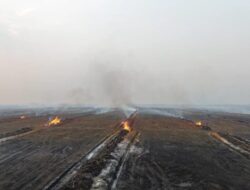
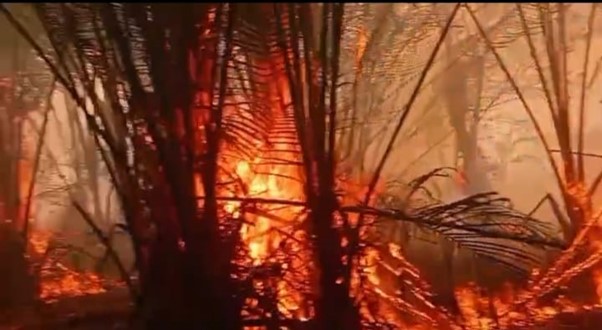
Jayapura, Jubi – A fire that swept through sago groves and peatland in Turiram village, Kimaam district, Merauke regency, South Papua, is threatening the food supply and livelihoods of Indigenous communities.
Residents are urging the government to respond urgently, investigate the cause of the fire and ensure their customary lands are protected.
Adrianus Tampiama Werre, a young member of the Kimaam Indigenous community, said the fire occurred on October 17 and 18, 1016. The cause of the fire and those responsible remain unknown.

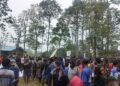

Werre said the fire, which had initially been extinguished, reignited, and spread easily into Indigenous-owned sago groves. The Kimaam area is dominated by peatland and was experiencing dry-season conditions, making the fire more difficult to contain.
“When the fire broke out, everyone in the community mobilised to put it out. The sago groves that burned are a source of livelihood for the community,” Were told Jubi via messaging app on Monday, October 26, 2026.
He estimated that between 100 and 200 hectares had been affected. However, the figure has not been verified through field assessments, and the actual extent of the burned area, the number of damaged sago clumps and the boundaries of the fire-affected zone remain to be established.
Werre said that the community could not fully rely on rice as a substitute for local food. Limited farming equipment and environmental conditions posed challenges for residents seeking to grow rice.
The peatland environment in Kimaam makes agricultural activities highly dependent on the weather. During the dry season, the area experiences drought, while some locations are vulnerable to flooding during the rainy season.
The fire has also compounded existing difficulties in accessing clean water.
Werre said residents of coastal Turiram village relied on wells for fresh water. When the wells dried up, they struggled to obtain enough water for daily needs.
Some residents then returned to older settlements od customary groves where water and sago remained available.
Werre said these movements were not caused by the fire alone, but were also linked to environmental conditions and the availability of resources needed to sustain life.
He said residents could move back to areas such as Pulau Pasir and other locations where they could obtain sago, catch fish and continue their daily activities.
“Water has become difficult to access, and the sago has burned. People are eventually looking for places where they can live more comfortably and continue their lives,” he said.
Werre called on the government to help affected families rebuild their homes. The area’s geographical isolation poses an additional challenge to responding to the fire and supporting those affected.
He said travelling by motorbike from Turiram village to the Kimaam district centre took about on to two hours, while the journey on foot could take an entire day.
Limited access and communications networks have also made it difficult to relay information about residents’ circumstances to the authorities.
Mikel Kacaburu, the customary chief of Mambum village, said he was at the site when the fire broke out on October 17.
He said the flames had reached and burned Indigenous-owned sago groves, causing panic and concern because the groves were central to the community’s survival.
Kacaburu said residents could not yet determine what caused the fire or where it had started. He called on the authorities and relevant agencies to conduct a thorough and transparent investigation.
“We do not want to speculate about the cause of the fire. We ask the relevant authorities to conduct an open investigation so that the cause can be established,” the Kimaam Indigenous community said in a statement.
The community is urging the Merauke regency government, the South Papua provincial government, the Regional Disaster Management Agency (BPBP) and other relevant agencies to visit the affected areas as soon as possible.
Residents want the government to provide firefighting assistance and equipment, assess the extent of the damage and calculate the losses suffered by the community.
Kacaburu said the burning of sago groves threatened not only food supplies but also vegetation, wildlife habitats and natural resources that sustain Indigenous livelihoods.
The potential health impacts, including exposure to smoke, and disruptions to daily activities also needed to be monitored, he said.
Residents are calling for the response to go beyond extinguishing fire. They want emergency assistance for affected familied and recovery plan to restore damaged food sources.
The community is also asking the government to establish whether the burned area is near a National Strategic Project (PSN) concession in Merauke.
Kacaburu stressed that residents had no evidence establishing a link between the fire and investment activities or large-scale development projects.
He called for field inspections and the public release of the findings.
Kacaburu also expressed concern about investment plans and the development of food estates in South Papua, sating large-scale projects could affect Indigenous communities’ living spaces.
He said Kimaam’s low-lying terrain and peatland environment needed to be considered before the government made decisions about large-scale development.
He feared land clearing with heavy machinery could damage the soil, disrupt ecosystem and threaten sago groves and other local food sources.
“If companies come in, the community will be threatened. Local food could disappear, fish could become harder to find, and sago could also become more difficult to obtain,” Kacaburu said.
He said the Kimaam Indigenous community wanted to maintain its relationship with the environment.
For local residents, he said, the natural environment was not merely a place to live but also a source of food and a living space inherited from the ancestors.
Kacaburu urged the government not to make decisions solely from Merauke, Jayapura or Jakarta, but to visit Kimaam, observe conditions on the ground and listen directly to the community.
Residents need transparent information about development plans, better road access and infrastructure, and meaningful participation in decisions affecting their customary lands, he said.
“The government must come and sit down with the community. People need clear information so they can understand whether a development plan is compatible with their way of life,” he said.
The Kimaam Indigenous community stressed that sago groves were more than forest areas. They were sources of food and livelihoods, as well as ancestral legacy that need protection.
Residents are calling on the government extinguish the fire, transparently investigate its cause, assess the damage, help affected families and guarantee the protection of sago groves and customary lands.
They are also demanding that their customary territories not be converted to other uses without respects for Indigenous rights.
For the Kimaam community, protecting sago groves is directly linked to the survical of both present and future generations.
Damage to local food sources could further increase the community’s vulnerability, particularly as access to clean water and other livelihood resources remains limited. (*)