
Jayapura, Jubi – The intervening defendant (third party) in a lawsuit challenging a Merauke regent’s decree authorising the construction of a 135-kilometre road in Ilwayab District, South Papua Province, presented two witnesses during a continued hearing at the Jayapura Administrative Court (PTUN) on Tuesday, 28 July 2026.
The hearing focused on the submission of additional documentary evidence by the parties and the examination of witnesses presented by Defendant II, the intervening party.
The panel of judges was chaired by Merna Cinthia, with Irfan Amos Sampe and Adjadam Riyange Zulfachmi serving as panel members.
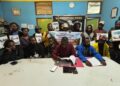


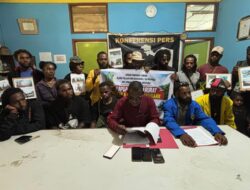
The lawsuit was filed by five representatives of the Malind Indigenous community, who are challenging Merauke Regent Decree No. 100.3.3.2/1105 of 2025, which granted environmental feasibility approval for the construction of a 135-kilometre access road in Ilwayab District as part of the Indonesian Ministry of Defence’s food security programme. The case was registered with the Jayapura Administrative Court under case number 9/G/LH/2026/PTUN Jayapura on 5 March 2026.
The first witness, Daniel Turot, a civil engineer with state-owned construction company PT Hutama Karya, testified that he had worked as a site supervisor since June 2021.
He said he was assigned to the disputed road project under a deployment letter dated 3 October 2025 and was responsible for construction between kilometre 58 and kilometre 86.
According to Turot, no road construction had begun when he first arrived at the site. His responsibilities were limited to technical construction work, while land acquisition and community consultation were handled by other parties.
However, he acknowledged participating in community meetings during the project’s mobilisation phase in Salamepe Village and the surrounding Nakias area.
“Our presence at the time was simply to seek permission for the work to proceed,” Turot told the court.
He said the company met with four Indigenous customary groups in January 2026, resulting in an agreement documented in an official record. The agreement included approval for road construction between kilometre 58 and kilometre 135, the employment of customary landowners in the project, and the payment of customary permission fees to the four Indigenous groups.
Turot also acknowledged that the project had encountered protests and road blockades by local residents.
“The company approached the community, and the work was eventually able to continue,” he said.
He explained that the initial stage of the project focused on clearing the road corridor to prepare for construction. Once the corridor had been opened, Indigenous communities were able to identify the boundaries of their customary land, although the formal demarcation of those boundaries was the responsibility of a government-appointed team rather than the contractor.
The second witness, Hasan, who serves as a public relations officer at PT Pembangunan Perumahan, told the court he had only been in the role for three months and was responsible solely for work on the second section of the road project.
He said his knowledge was limited to the area under his supervision and that he was unfamiliar with conditions along the entire 135-kilometre route before construction began or with work carried out outside his assigned section.
Hasan also said he had never received information about companies that had previously worked on the project and was not informed about earlier contractors or construction progress before he joined.
“At present, the work is proceeding smoothly and safely. Indigenous communities have not raised objections to the road construction, and this project is solely for road development and is unrelated to the rice field programme,” Hasan testified.
Lawyer for the plaintiffs, Emanuel Gobay, argued that the testimony of both witnesses actually strengthened the plaintiffs’ case.
According to Gobay, the witness from PT Hutama Karya acknowledged that the project involved clearing forests on swamp land and in areas traditionally used by Indigenous communities for hunting and gathering.
He also noted that the witness confirmed there had been both support for and opposition to the project within local communities.
“That admission reinforces the plaintiffs’ argument that the construction has affected customary land and the livelihoods of Indigenous communities,” Gobay said.
Gobay added that the witness admitted he did not know whether permits had been obtained for logging or clearing trees within customary forests, despite stating that his contract covered only road construction.
Regarding Hasan’s testimony, Gobay said the witness had worked on the project for only about three months, limiting the scope of his evidence.
Nevertheless, Gobay said two significant points had emerged from the testimony: the presence of many military personnel providing security for the project and the witness’s acknowledgement that construction activities had already been underway before he joined the project.
“That testimony strengthens the allegation that road construction began in 2024, while the environmental permit being challenged in this case was only issued in 2025,” Gobay said.
He argued that this indicated construction had commenced before the environmental approval was granted. Gobay urged the panel of judges to carefully examine documents referred to by the witnesses during the hearing but which had not yet been submitted as documentary evidence.
“We hope the trial proceeds professionally, objectively, and with full consideration of all the facts and evidence presented,” he said.
Meanwhile, Antonius Victor Kaisiepo of the Merauke Regency Secretariat’s Legal Bureau said both witnesses were directly involved in carrying out the physical construction of the 135-kilometre road and had testified based on their own experience in the field.
Responding to questions about an environmental permit covering only a five-kilometre section, counsel for the defendants said the road had always been planned as a single 135-kilometre project.
He said the permit for the initial five kilometres represented the first phase of the overall project and that supporting documents would be submitted to the court as evidence.
“The project forms part of a National Strategic Project involving ministries at the national level,” Victor Kaisiepo said.
He added that the regional government had acted within its legal authority, and that the administrative and licensing process would be demonstrated through official documents to be presented before the court.
At the next hearing, the intervening defendant will call an expert witness and submit additional documents requested by the panel of judges.
“These include the relevant decrees and documents concerning the release of forest areas as part of the evidentiary process,” he said.
The trial is scheduled to resume on 11 August 2026, when both parties will present expert testimony. (*)