
Jayapura, Jubi – Flooding is a recurring problem in Jayapura City, Papua province. Its hilly terrain and high rainfall make many areas vulnerable to floods and landslides. Adding to the problem, the city also faces the risk of clean water shortages despite being frequently inundated by rain.
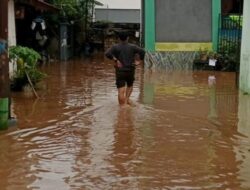
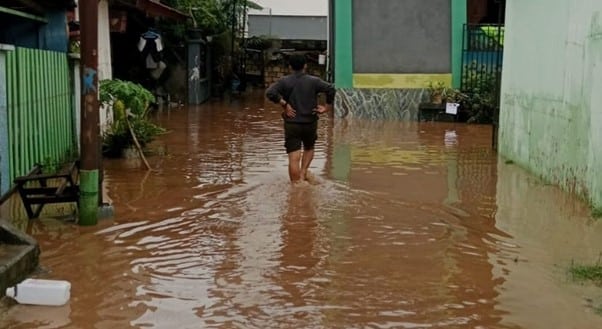
Heavy rain that hit Jayapura City on October 8 and 9, 2026, triggered flooding, inundating roads, commercial areas, government building compounds and residents’ homes in Abepura district.
As of October 26, traces of mud left by the flooding were still visible on the walls of houses in Gang Matoa, in the BTN Organda residential area.


Paint had peeled off and faded on residents’ walls, while brown mud stains remained along the narrow lane, which has no drainage system.
One resident, 49-year-old Aser Marisan, said rain on October 9 caused a small creek to overflow, flooding Gang Matoa and neighbouring lanes.
“The small creek overflowed from there, and the water immediately entered our houses,” Marisan told Jubi.
Several houses in Gang Matoa have since been left vacant and abandoned.
“Everything was covered in mud. These four houses have already been abandoned by their occupants,” Marisan said.
Marisan has lived in a 36-square-metre house in the residential area since 2000 and has experienced repeated flooding over the years.
“If it rains heavily for just one or two hours, that’s it. We’re done,” he said.
The October 9 rainfall also flooded homes in the BTN Puskopad Kamkey residential area in Abepura district.
Yuliana Sada, a resident, said the floodwaters carried mud eroded from nearby hillsides. The sediment clogged drainage channels, causing rainwater to overflow into residents’ homes.
Sada complained about the drainage system serving houses higher up in the BTN Puskopad Kamkey area. Pipes from the upper section of the residential area channelled floodwater towards homes below.
“The drainage pipes from the people living uphill carry the water down when flooding occurs. Whenever there is heavy rain, the water usually flows into our houses,” she said.
She said floodwater mixed with mud was difficult to clean. Once the mud dried, it left dust throughout the house.
“We live in the lower section, so we bear the brunt of the impact. The muddy soil brought in by the floods makes the house dusty,” Sada told Jubi on Thursday, October 22.
A recurring problem
The rain that hit Jayapura on October 8 and 9, 2026, was particularly heavy.
An analysis by the Meteorology, Climatology and Geophysics Agency (BMKG) Region V Jayapura recorded moderate to heavy rainfall across Jayapura City and Jayapura Regency from 10pm local time on October 8 until 9am on October 9.
Rainfall reached between 92.6 millimetres and 118.2 millimetres per day.
The downpour triggered flooding in Abepura, Heram, North Jayapura and South Jayapura districts, inundating several roads and residential areas. A landslide was also reported along Skyline Road in South Jayapura.
Windy, a weather forecaster at BMKG’s Region V Jayapura office, said the agency’s analysis identified atmospheric disturbances that contributed to the heavy rainfall on October 8 and 9.
These included changes in wind direction and wind convergence, as well as activity associated with the Madden-Julian Oscillation (MJO) over Papua.
“Another contributing factor was the relatively warm sea surface temperature north of Papua, combined with high atmospheric moisture levels in the 850, 700 and 500 millibar layers,” Windy told Jubi at the BMKG Region V Jayapura office on Thursday.
Windy said atmospheric disturbances, including the Madden-Julian Oscillation (MJO), contributed to the development of rain clouds, followed by heavy rainfall.
On October 8, 2026, the Papua Climatology Station recorded rainfall of 118.2 millimetres per day, classified as very heavy rainfall.
Meanwhile, the Automatic Weather Station (AWS) Digi Stamet Sentani in Jayapura Regency recorded 117.2 millimetres per day, also classified as very heavy rainfall. Heavy downpours were also recorded by the Automatic Agroclimate Weather Station in Nimboran, Jayapura Regency, which measured 107.2 millimetres per day.
Heavy to very heavy rainfall, defined as more than 50 millimetres per day, was recorded across a wide area.
The measurements included 98.6 millimetres per day at Sentani Meteorological Station, 84.6 millimetres at ARG Karya Bumi, 91.4 millimetres at ARG Benyom Jaya, 38 millimetres at ARG Karoeh, 98.1 millimetres at AWS Balai V, 92.9 millimetres at Dok II Maritime Meteorological Station, 92 millimetres at AWS Digi Dok II and 74.8 millimetres at AWS Jayapura Port.
“The rainfall recorded in Jayapura City and Jayapura Regency between October 8 and 9 was classified as heavy to very heavy. Areas that have long been prone to flooding were immediately affected by the downpour,” Windy said.
However, flooding has continued to return to Jayapura year after year, forcing residents to find their own ways of coping with the recurring disasters.
Marisan said that in 2019, floodwaters reached one metre inside his home and remained there for a week.
The flood damaged his refrigerator, mattresses and an active speaker system he had bought in Port Moresby, Papua New Guinea. It also destroyed three water pumps connected to his household bore well, leaving him without a reliable source of clean water.
“Many things could not be salvaged. The house was already empty. We had large speakers and a sound system for events, and everything was destroyed. At the time, we had spent almost hundreds of millions of rupiah on them. Most of the active speakers could not be rescued in time because the floodwater entered through the windows,” Marisan said.
He has since built elevated shelves inside his home to protect valuable belongings from future floods.
“We have built raised shelves inside the house to keep important belongings. Once everything is safely up high, we can just leave and sit outside. If the flooding gets worse, we can run to relatives who live nearby,” he said.
Marisan hopes to eventually have enough money to raise the level of his house.
“Perhaps each of us could build our houses on higher ground. But relying on the government is difficult,” he said.
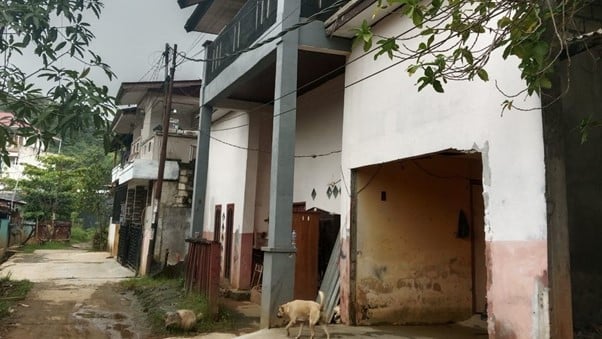
Ayu, a resident of Entrop in Jayapura City, said her home was once inundated by floodwaters reaching one metre in height in 2022. At the time, flooding and landslides affected 19,914 people across Jayapura City and claimed eight lives.
Ayu said the major flood four years ago submerged her sofa and swept away her food cart. She managed to escape the rising water by taking shelter on the second floor of her house.
“We didn’t evacuate. We went upstairs to the second floor. If we hadn’t made it up there in time, we would have been in serious trouble. My food cart was swept away and got stuck against the fence of a meatball vendor. The sofa was completely submerged,” Ayu said.
She said Entrop was among the areas regularly affected by flooding. Other flood-prone locations included Youtefa Market, the Kotaraja traffic lights, the Organda residential area and areas around the Acai River in Abepura.
“It’s not flooded every day. The major flood happened in 2022. Flooding does happen here, but the water usually recedes quickly. These days, when it rains, water only accumulates along the lane before draining away. During the recent flooding in early October, for example, the water did not enter our house,” she said.
Immanuel Witapo, a resident of Padang Bulan, said his home was also regularly affected by flooding.
Whenever Perumnas 4 or the Yahukimo Regency Girls’ Dormitory flooded, he knew it was only a matter of time before water reached his house, sometimes rising to knee or even waist height.
“When flooding occurs in this area, the water eventually enters my house,” Witapo told Jubi on Saturday, October 24, 2026.
Floodwaters often carry mud into residents’ homes, damaging mattresses and kitchen utensils. Having experienced repeated flooding, Witapo said he remained on alert whenever it rained.
“Just this morning, we were still asleep. But when it started raining, we woke up and immediately moved our belongings because we were afraid of flooding. We are always on alert. As soon as it rains, we move our things to higher places,” he said.
Another Perumnas 4 Waena resident, Bartolomeus, said flooding in the area had become increasingly severe. In the past, floodwaters only covered the roads in Perumnas 4.
“[But] now [the floodwater] can reach inside people’s homes. That is why residents living here take precautions against flooding whenever it rains,” he said.
Rain in Jayapura City not only causes muddy flooding and increases the risk of landslides. Residents such as Immanuel Witapo have also come to expect heavy rain to make the water supplied by PT Air Minum Jayapura murky and unsuitable for use.
“When it rains, the water becomes murky. So, we must wait another two days [until it clears] before we can collect it. It still rains in Jayapura, but water is difficult to get. I am not satisfied with PT Air Minum Jayapura’s service because the water runs out quickly. It was also overpriced,” Witapo said.
Witapo has been a customer of PT Air Minum Jayapura since 2022. He said the company’s water supply service did not justify the high monthly bills. The water becomes murky during the rainy season, while during prolonged dry spells, supply is rationed.
“We pay Rp300,000 a month for water services, but water only flows once or twice a week,” said the Perumnas 4 Waena resident.
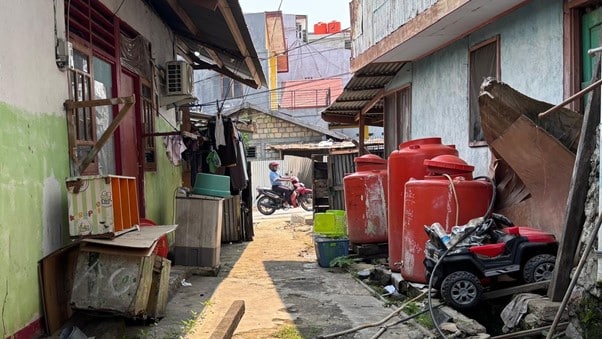
Like many other PT Air Minum Jayapura customers, Witapo owns two 550-litre water tanks. He uses the tanks to store the utility’s water for cooking, drinking, washing and bathing. He also collects rainwater in old paint buckets, which he reserves for flushing the toilet.
Yuliana Sada also complained about PT Air Minum Jayapura’s water supply. When it rains, the water flowing from the utility’s tap at her home turns murkyut and brownish. During the dry season, supply is rationed, with water delivered only twice a week.
Sada relies on the utility’s water for cooking, drinking, washing and bathing. In late October 2026, water flowed to her home only on Mondays and Thursdays. She has four 550-litre tanks to store the supply. When the stored water runs out, she usually buys bottled water in large refill containers.
Aser Marisan stopped subscribing to PT Air Minum Jayapura in 2019. He said the water supply was intermittent despite the high bills. Instead, he spent Rp5 million to build a bore well. He said this had given him greater confidence that his household would not run short of clean water.
“Since around 2019, we have stopped using the municipal water supply. We now use a bore well, so we are safe. [Even] when flooding occurs, my well water remains clean and flows normally. We just move the [water] pump upstairs to keep it safe and prevent it from being submerged,” he said.
Mitigation amid budget constraints
Jayapura City Disaster Management Agency (BPBD) head Yayong Baddu said the city lies below the slopes of the Cycloop Mountains. Its topography makes many areas vulnerable to flooding and landslides during heavy rainfall.
Baddu said the risks remained despite forecasts that El Niño would continue into early 2027.
“Jayapura City is different from other areas. While other regions are still experiencing drought, we can suddenly get heavy rain, as happened on October 9. We are now clearing all the drainage channels in the Tanah Hitam area,” Baddu told Jubi at his office on Thursday, October 22, 2026.
According to Baddu, Jayapura City is among five areas identified by the Papua provincial BPBD as vulnerable to flooding. The other areas are Jayapura Regency, Keerom Regency, Mamberamo Raya Regency, Waropen Regency and Sarmi Regency.
Data from the National Disaster Management Agency (BNPB) show that between 2022 and 2025, Jayapura City experienced four major floods, one disaster caused by extreme weather and one landslide. During that period, 10 people died, 17 were injured, 1,538 houses were damaged and 147 houses were inundated.
“Its topography is varied, with mountains, valleys, beaches, lakes and rivers. The land descends from the mountains to swamp areas and then further down to the coast. [This] makes the city prone to frequent flooding,” he said.
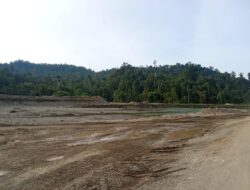
Baddu said forest clearing on the slopes of Mount Cycloop for settlements and gardens had also increased the risk of flooding and landslides. Gold-mining activities in Polimak had contributed to the problem as well.
Clearing forests on steep slopes and mining activities make hilly areas more vulnerable to erosion. The resulting sediment can cause rivers to become shallower and disrupt drainage systems across Jayapura City.
The rivers’ capacity to carry water during heavy rainfall has consequently declined. Baddu said some rivers, which were once 10 metres deep, had become shallower because floodwaters carried sediment from eroded slopes downstream.
Several river catchment areas in Jayapura City have experienced sediment build-up, including the Anafre, Kampwolker, Siborgonyi, Acai and Entrop rivers.
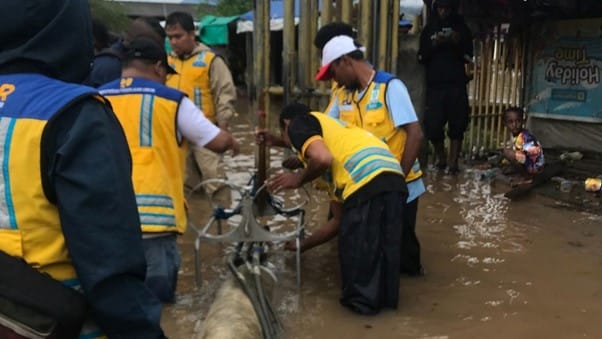
Following the October 9, 2026 floods, several rivers became blocked or shallower due to mud and sediment washed downstream from the BTN Puskopad Kamkey housing area. Baddu said his agency was now clearing flood sediment from the Acai and Siborgonyi rivers.
“The October 9 incident affected five districts in Jayapura City. [We are now] carrying out mitigation measures and monitoring areas affected by flooding and landslides,” Baddu said.
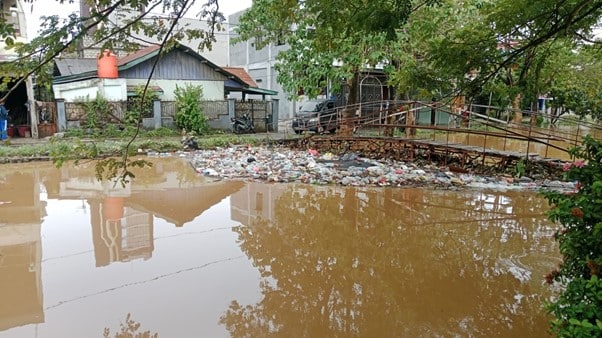
Regarding the recurring floods in residential areas across Jayapura City, Baddu said many drainage channels and rivers had become clogged with rubbish dumped by residents.
Data from the Jayapura City Environmental and Sanitation Agency (DLHK) show that households and businesses in the city generate 242.5 tonnes of waste each day.
Of that amount, the agency can collect only 174.38 tonnes daily. The remaining 68.12 tonnes of uncollected waste ends up in drainage channels and rivers.
“People’s habit of dumping rubbish indiscriminately also contributes to [flooding]. As a result, debris accumulates and rivers become shallower,” Baddu said.
The rainy season is now approaching. Windy, a weather forecaster at the Jayapura Region V Meteorology, Climatology and Geophysics Agency (BMKG) Regional Forecasting Centre, said the rainy season in Papua began in the third ten-day period of October and the first ten-day period of November.
Areas entering the rainy season in the third ten-day period of October include parts of Jayapura, Keerom, northern Pegunungan Bintang, northern Yahukimo, Jayawijaya, Lanny Jaya, Mamberamo Tengah, Yalimo, Tolikara, Puncak and Puncak Jaya. Areas expected to enter the rainy season in the first ten-day period of November include northern Jayapura and eastern Sarmi.
Windy said the peak of the rainy season was forecast for around January to February 2027, with rainfall expected to be within the normal range. She said the potential impact of La Niña, which can bring wetter-than-usual conditions, during that period remained uncertain because the El Niño-Southern Oscillation (ENSO) was still in the very strong El Niño category.
“This rainy-season forecast is important information for local governments and communities as they prepare for potential extreme weather, including heavy rainfall and flooding,” she said.
Without adequate preparation, the rainy season could bring further flooding. Jayapura City BPBD head of Rehabilitation and Reconstruction, Ronald Turangan, said the agency had issued a written assessment outlining the importance of mitigating flood risks. The document had been sent to various government agencies, including public works and housing departments at the regency and provincial levels.
The BPBD assessment recommended cooperation on measures to mitigate hydrometeorological disasters. Ronald said these could include dredging river channels in Jayapura City, planting vegetation and building rainwater infiltration and storage facilities.
According to Ronald, Jayapura City needs at least 20 river catchment maintenance projects each year, targeting flood-prone locations and important waterways. One priority for dredging is the Acai River, which can carry rainwater out to sea and help prevent flooding.
“The Acai River needs to be dredged, but we also need to [engineer the system to] increase its water storage capacity. If the volume of rainwater discharged into it is large but its capacity is small, [the river] cannot carry the water out to sea,” Ronald said.
Ronald estimated that maintaining one river catchment area costs between Rp500 million and Rp1 billion annually, depending on the size of the waterway.
However, funding for river maintenance has been reduced because Jayapura City’s finances have been affected by the central government’s budget efficiency measures.
“As a result, maintenance is limited to locations considered priority channels for carrying the largest volumes of water. On the positive side, the Jayapura City Government is not working alone on river maintenance. The river basin authorities and regional river basin agency are also helping,” he said.
Yayong Baddu confirmed that funding for managing hydrometeorological disasters was limited. One reason was cut to the central government’s regional transfers to local administrations. Baddu declined to disclose the Jayapura City BPBD’s total budget for 2026.
Instead, he referred to the agency’s 2025 budget of Rp5 billion. Of that amount, around Rp3 billion was used for personnel expenditure, including salaries for the agency’s 41 employees. He did not provide a breakdown of how the remaining Rp2 billion was spent.
“Our budget is limited, and much of it goes towards staff salaries. Other spending covers activities such as building and maintaining retaining walls,” he said.
To respond to floods and landslides, the Jayapura City BPBD relies on two boats, one multipurpose truck, one box truck, two pickup trucks, one portable toilet vehicle, five large tents and two small tents.
Baddu said the agency’s limited budget, personnel and equipment meant it could not manage floods and landslides on its own. In practice, he said, responses to hydrometeorological disasters required coordination across several sectors, including the Public Works Agency, the Regional River Basin Agency, the road authority, and the Indonesian Military and National Police.
“We know that our area is prone to flooding and landslides. So, if we rely on the BPBD alone, we simply cannot cope,” he said.
Protecting clean water to prevent flooding
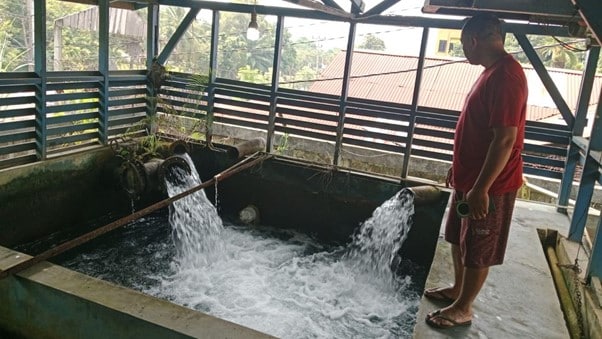
Water remains a major challenge in Jayapura City. During the rainy season, the capital of Papua province is frequently hit by floods and even landslides. Heavy rain also contaminates water distributed to customers by PT Air Minum Jayapura. Conversely, during the dry season, thousands of the utility’s customers, including Immanuel Witapo and Yuliana Sada, receive water only twice a week.
PT Air Minum Jayapura technical director Yan Pieter Nasadit acknowledged that the company often rations water supplies to customers. He said rationing occurred when the volume of clean water produced by the company’s six distribution branches declined.
PT Air Minum Jayapura distributes water through six branches: North Jayapura, South Jayapura, Jayapura, Waena, Sentani and Muara Tami.
Nasadit said the company operated 23 water intake facilities across 11 water sources. Each distribution branch has its own intake facilities, which operate independently and are not interconnected.
The company’s intake facilities include Ampera, Inafare 1 and 2, APO, Bantuan, Borgonji, upper and lower Buper, upper and lower Entrop, and Kali Biru Ajen. Others include Kamp, Kampwolker 1 and 2, Kore, Paulus Dok V, Polimak IV, Dok II Regional Hospital and Tyveun.
Together, the 23 intake facilities are designed to produce 798.89 litres of water per second. However, their output declines during the dry season.
Through these 23 intake facilities, PT Air Minum Jayapura serves 41,738 customers across Jayapura City and Jayapura Regency. Nasadit said the company’s total water production could fall to 400 litres per second during the dry season.
When water production declines, PT Air Minum Jayapura reduces the number of hours it supplies water to customers.
“For example, customers who previously received water for 12 hours may have their supply reduced to six hours. Those who received water for 24 hours may have it reduced to 12 hours. However, the schedule remains consistent, and we always inform customers about it. These schedule changes are due to declining water levels,” he said.
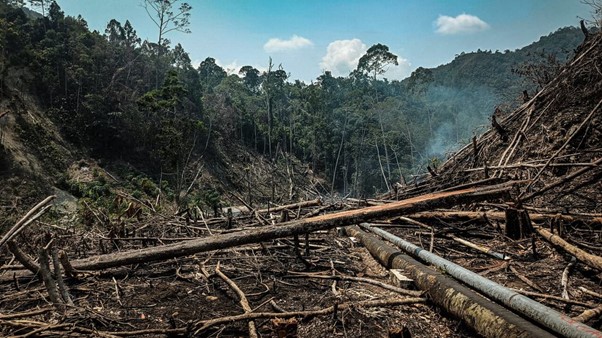
Nasadit said water levels at PT Air Minum Jayapura’s intake facilities had declined because of forest clearing in the catchment areas of its 11 water sources.
He cited the condition of the Kampwolker water source, which supplies customers in Abepura, South Jayapura and North Jayapura districts.
“The conditions are no longer the same as they used to be,” he said.
On October 24, 2026, Jubi visited the Kampwolker 1 and Kampwolker 2 intake facilities in Perumnas 3 Waena. Water levels at both facilities appeared to have dropped significantly. The water filters at both intakes were damaged and rusted, while leaking pipes were spraying water.
Along the Kampwolker River, Jubi identified four locations where residents had cleared land. Jubi also saw residents clearing land and burning fields in the area. Other plots had already been planted with taro, bananas, sweet potatoes and vegetables.
Nasadit acknowledged the situation.
“That area has indeed been cleared and no longer looks as it did before. Our staff have seen these conditions firsthand, in the area upstream of the Worker River. We cannot intervene or prohibit residents from clearing the forest,” he said.
Nasadit said similar conditions could be found around several other water sources. At the Anafre and Angkasa intake facilities, for example, areas that were once covered with trees had been cleared and planted with various crops, including pineapples, chillies and tomatoes.
“Now, during the dry season, if there is no rain for a month, water levels will certainly decline,” he said.
Dr Lieza Corsita, head of the Centre for Sustainable Environmental Infrastructure Studies at the Jayapura University of Science and Technology, said the El Niño weather phenomenon was affecting climatic conditions across Papua, including Jayapura City.
Lieza said water production at PT Air Minum Jayapura’s intake facilities in Jayapura City and Jayapura Regency had fallen by as much as 50 per cent.
“The strong El Niño is contributing to a prolonged drought,” she said.
Lieza said access to clean water was becoming an increasingly serious problem in Jayapura City and Jayapura Regency. Heavy rainfall no longer automatically translated into greater water availability because forest cover across both areas had continued to decline.
She said catchment areas in the Cycloop Mountains were increasingly degraded.
“This is affecting the water levels in the sources we rely on,” she said.
She warned that demand for clean water would continue to rise alongside population growth. Average water consumption in Jayapura currently stands at around 113.48 litres per person per day. Lieza noted that water use in the non-domestic sector was also increasing as business activities and development expanded across the region.
The number of household water connections, previously around 32,000, had continued to grow and was now estimated at approximately 40,000. The number of customers was estimated at around 41,600 in Jayapura City and 4,300 in the Sentani area.
Lieza said total demand for clean water in Jayapura City and Jayapura Regency was projected to increase from around 451 litres per second to 557 litres per second.
If water production fell to approximately 350 litres per second while demand reached 557 litres per second, the resulting supply shortfall would be substantial.
“The problem is not just declining water levels. The number of consumers is also increasing, making it increasingly difficult for the available water supply to meet demand,” she said.
Water distribution by PT Air Minum Jayapura is also hampered by significant leakage across its pipe network. Data on water losses estimate that 179.75 litres of water are lost every second due to leaking pipes.
“Water losses from leakage reach 179.75 litres per second. That is extremely high and is another problem,” Lieza said.
Nasadit said the company was waiting for the construction of a water treatment plant using water from Lake Sentani. The facility is planned for an area along the alternative road behind Cenderawasih University’s campus in Waena.
“In principle, we are ready to carry out our responsibilities as the operator, in accordance with the joint decision,” he said.
Nasadit said once the Lake Sentani water treatment plant became operational, water supplies to Tanah Hitam, Abepura Pantai, coastal communities such as Tobati and Enggros villages, and Polimak would increase.
The planned facility is expected to provide an additional capacity of between 100 and 200 litres per second.
Lieza Corsita said her team was preparing the Environmental Impact Analysis (ANDAL) document for the proposed Lake Sentani water treatment plant.
The project is estimated to cost Rp200 million, with an installed capacity of around 250 litres per second. However, its initial water treatment capacity is expected to be approximately 125 litres per second.
“Lake Sentani is our only water source that can withstand drought because it has water in both the rainy and dry seasons. However, its water quality is somewhat polluted. There are technologies we can use to treat the lake water so that it is safe for consumption or can be used as a raw water source,” she said.
A water treatment plant at Lake Sentani could help address the risk of a water crisis in Jayapura City. However, building a treatment plant would not mitigate the risks of flooding and landslides.
Jayapura City BPBD head of Rehabilitation and Reconstruction Ronald Turangan proposed reducing flood and landslide risks by planting vegetation and trees that could strengthen soil structure.
He said the Jayapura City BPBD had mapped areas requiring reforestation, including North Jayapura, South Jayapura, Abepura and Heram districts.
Ronald also proposed building a retention basin to collect rainwater and surface runoff in the Kolam Buaya Entrop area of Jayapura City.
He said the existing retention basin near State Senior High School 4 Jayapura was too small and could no longer accommodate the volume of water generated by heavy rainfall.
“One proposal is to build a small dam upstream of Kolam Buaya. This would slow the flow of water downstream so that we could temporarily store it. Under normal conditions, we could then release the water gradually. There are several stages of work that could be carried out there,” he said.
Lieza said the Papua Provincial Government should plan to build a dam to collect rainwater. The stored water could then be treated as a source of raw water and kept as a reserve for use during the dry season.
“Jayapura has limited infrastructure for storing water. Perhaps in the future we will need to build a dam so that rainwater can be collected when it falls,” she said. (*)
Theo Kellen, Aida Ulim and Larius Kogoya contributed to this article.
This report was supported by Comslab as part of a journalistic collaboration titled “The Threat of Hydrometeorological Disasters in Papua.”