Jayapura, Jubi – The Papua Natural Resources Conservation Agency (BBKSDA Papua), in collaboration with WWF-Indonesia’s Papua Programme, is developing a conservation strategy to support the recovery of endangered pig-nosed turtle populations in Southern Papua.
Fikri Al-Mubarok, a junior forest ecosystem controller at BBKSDA Papua, said in Jayapura on Friday that a conservation Strategy and Action Plan (SRAK) was needed to ensure efforts to protect and restore the turtle population were targeted, measurable and sustainable.
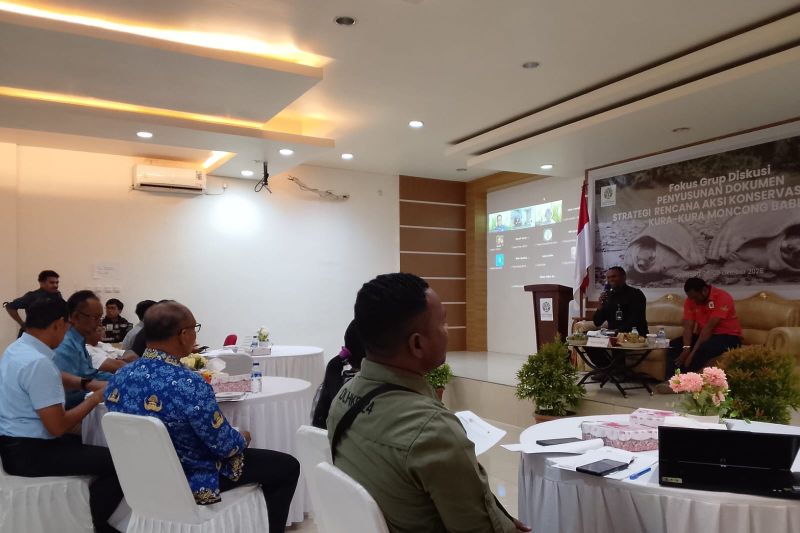
“On Thursday (October 29), we worked with WWF, Indigenous communities, academics, researchers and other stakeholders to develop a strategy for protecting and restoring the pig-nosed turtle population. The discussion was held at the BBKSDA Papua office through a Focus Group Discussion (FGD),” he said.


According to Fikri, without a clear conservation strategy and measurable population recovery targets, efforts to protect the species risk becoming fragmented, poorly coordinated and difficult to evaluate.
“Based on our 2023 surveys and monitoring, pig-nosed turtle habitats are spread across six regencies in southern Papua: Asmat, Merauke, Nduga, Mappi, Mimika, and Boven Digoel,” he said.
He explained that the species depends on freshwater ecosystems, including rivers, wetlands and surrounding areas. However, its population faces threats from hunting, illegal trade, egg collection and habitat degradation caused by environmental changes.
“Under Environment and Forestry Ministerial Regulation No. P.106/2018, the pig-nosed turtle is a protected species. Internationally, it is classified as Endangered (EN) on the IUCN Red List and listed in Appendix II of CITES,” he said.
Fikri added that the conservation strategy and action plan was expected to provide clear direction and priorities for population recovery, while strengthening habitat protection through multi-stakeholder collaboration based on scientific data.
Meanwhile, Ikhsan Anggoda, biodiversity and climate specialist at WWF-Indonesia’s Papua Programme, said the proposed conservation strategy would cover population recovery with measurable targets, in-situ and ex-situ management, genetic diversity protection and the maintenance of habitat connectivity.
“The conservation assessment will begin with surveys at several points along rivers to determine habitat conditions and estimate the pig-nosed turtle population,” he said.
According to Ikhsan, the research is also expected to use the Capture-Mark-Recapture (CMR) method, which involves capturing and marking individual turtles before recapturing them to estimate population size.
The assessment will also identify habitat characteristics, including sandy substrates, nesting sites and vegetation along riverbanks.
“We hope the findings will provide a scientific basis for determining conservation priorities, strategies and approaches for pig-nosed turtle conservation that are suited to the actual conditions of its population and habitat,” he said. (*)