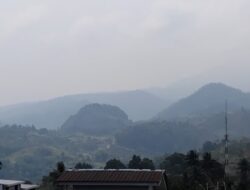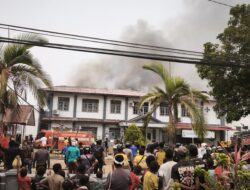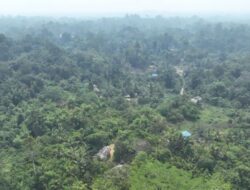
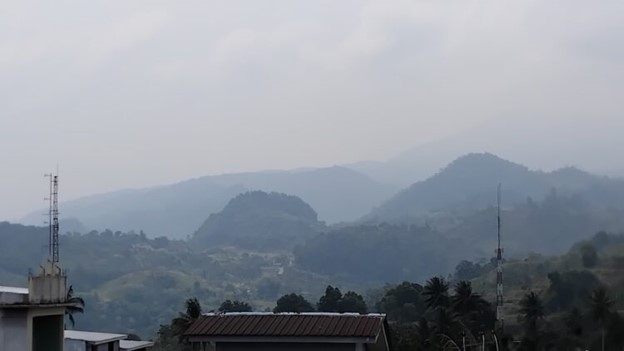
Jayapura, Jubi – Jayapura City and Jayapura Regency in Papua Province have been blanketed by smoke haze in recent days, believed to have originated from forest and land fires in northern Papua New Guinea (PNG).
Naufal Rieki, a weather forecaster with the Meteorology, Climatology and Geophysics Agency (BMKG) Region V in Jayapura, said BMKG monitoring between 9 and 11 October detected hotspots in Jayapura City, Jayapura Regency and surrounding areas, including Gresi Selatan District in Jayapura Regency.
Satellite imagery from Himawari also showed smoke haze across several parts of Papua, including Jayapura City and Jayapura Regency, during the same period.

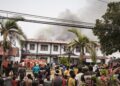

“This is caused by airborne particulate matter from the burning of organic material, such as forest and land fires in northern Papua New Guinea. Winds carried the particles west and north-west towards Jayapura City and Regency,” Naufal said on Monday (12 October 2026).
He said a separate land fire was also detected on 11 October on a hillside in Doyo Baru, Waibu District, Jayapura Regency.
The combination of the two events caused hazy conditions during the period, with a leyer of particulate matter accumulating close to the ground, he said.
Naufal said the Air Pollution Standard Index (ISPU) readings for Jayapura City and Regency between 10 and 12 October 2026 were in the moderate category, with PM2.5 levels ranging from 66 to 73.
“If smoke haze occurs, avoid open burning, keep doors and windows closed while the air is smoky, and continue monitoring information from BMKG,” he said.
BMKG monitoring between 2am Papua time on 11 October and 2am on 12 October detected 7,991 hotspots across Papua, Naufal said.
Of those, 7,002 had a moderate confidence level, 544 had a high confidence level and 445 had a low confidence level.
“During this monitoring period, many high-confidence hotspots were detected in Merauke Regency. The area requires particular attention because of the potential for land fires,” he said.
Merauke Regency in South Papua Province recorded the highest number of hotspots, with 4,910, followed by Boven Digoel Regency, also in South Papua, with 1,132, and Kaimana Regency in West Papua Province with 724.
Previously, the Wasur National Park Office said efforts to tackle forest and land fires had been hampered by drying vegetation, difficult terrain, and shortages of firefighting equipment and personnel.
Response efforts including patrols, firefighting, drone monitoring and community education.
Dry conditions have increased the risk of fires. Dried-out vegetation allows flames to spread more easily, while limited water supplies make firefighting more difficult.
The Wasur National Park Office said additional firefighting equipment and better coordination between agencies were needed to strengthen fire management efforts.
It also called for support from the central government, including possible aerial assistance to reach fires in remote and difficult-to-access areas. (*)