Manokwari, Jubi – West Papua Governor Dominggus Mandacan says poverty has declined and the economy has continued to grow during the 27 years since the province was established.
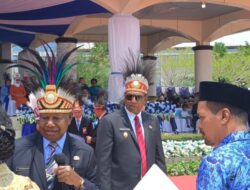
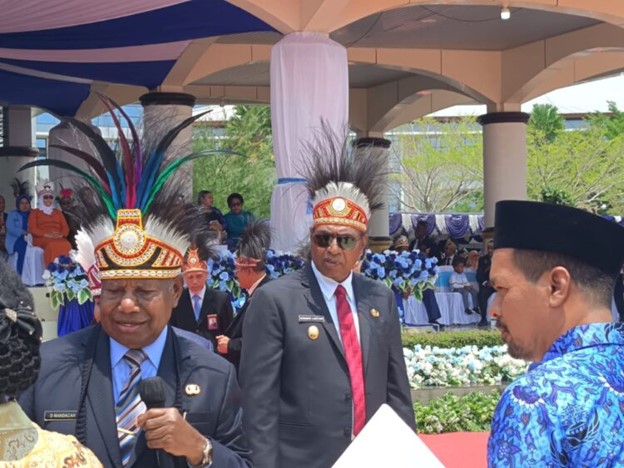
Mandacan made the remarks during celebration marking the 27th anniversary of West Papua Province on Monday (12/10/2026).
He said the province’s natural resources, including forestry, energy, agriculture and tourism, had helped strengthen the regional economy.



“The poverty rate in West Papua has declined significantly, from 21.69 per cent in 2024 to 19.59 per cent in September 2025, and 18.68 per cent in March 2026,” Mandacan said.
Meanwhile, West Papua’s Human Development Index (HDI) rose to 68.48 in 2025, up to 67.69 in 2024, he said.
West Papua was established under Law No. 45 of 1999 following the division of Papaua Province. It was initially called West Irian Jaya before being renamed West Papua under Government Regulation No. 24 of 2007.
“Over the course of West Papua Province’s development, progress has been made in infrastructure and governance, including the successful establishment of Southwest Papua as a new province,” Mandacan said.
He said development success should not be measured solely by the scale of investment or economic growth, but by whether its benefits were felt by Indigenous Papuans, particularly those living in villages.
During the anniversary celebrations, the provincial government launched three programmes: West Papua Cerdas (West Papua Education), West Papua Sehat (West Papua Healthy), and West Papua produktif (West Papua Productive),
Mandacan symbolically presented scholarships under the West Papua Cerdas Programme to 3,000 senior high school and vocational school students. Scholarships are also available to undergraduate and postgraduate students.
“The uniform assistance is Rp3 million, while students with outstanding academic achievements receive Rp2.6 million,” he said.
Mandacan said the provincial government had coordinated the West Papua Cerdas programme with regency governments. The province would provide scholarships to university students with a grade point average (GPA) of at least 2.3, with Rp10 million for undergraduate students and Rp20 million for postgraduate students.
He also symbolically launched the West Papua Sehat programme, which complements Indonesia’s national health insurance scheme administered by BPJS Kesehatan. Health insurance coverage in the province has reached 98.48 per cent.
“With BPJS and West Papua Sehat, there is no reason for people to struggle to access healthcare before the government covers the costs,” Mandacan said.
He said the 98.48 per cent coverage rate was supported by funding from the central, provincial and regency governments.
“West Papua Sehat complements BPJS Kesehatan services, particularly for medical needs not covered by the national health insurance scheme. The programme also helps people who require follow-up treatment unavailable at healthcare facilities in West Papua,” he said.
Mandacan said the provincial government had allocated Rp100 billion this year to PALKUAP, an association of Indigenous Papuan entrepreneurs, for distribution to local areas. He also referred to assistance involving 514 units, although further details were not provided.
A separate stimulus assistance programme has provided support to 393 recepients through the West Papua Office of Cooperatives and Micro, Small and Medium Enterprises as part of the West Papua Produktif initiative.
Mandacan said the provincial government was also creating employment opportunities through job fairs, recruiting workers for companies in the hospitality, oil palm plantation, cement manufacturing and bank sectors.
He said 656 workers would be placed in jobs, with 80 per cent of them Indigenous Papuans and the remaining 20 per cent non-Papuans. Employers included BP Tangguh, cement manufacturers, hotels and companies in the oil palm sector, including Medco.
Meanwhile, West Papua Legislative Council deputy speaker Petrus Makbon said the province had recorded numerous achievements under successive governors over its 27-year history.
“These achievements must be maintained. We hope the governor and deputy governor can further improve the welfare of people in West Papua during the final three years of their leadership,” Makbon said.
He also expressed hope that the province’s current leadership would further reduce poverty.
“Budgets are being streamlined now. Hopefully, funding will return to normal in the future so the province can meet its development needs,” he said. (*)