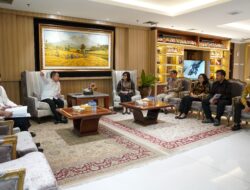

Jayapura, Jubi – The Department of Compassion and Justice of the Evangelical Christian Church (GKI) Synod in the Land of Papua has launched a week-long training program in Jayapura to equip people with disabilities with the skills to manufacture prosthetic arms and legs.
The training, which opened on Monday at the GKI Synod headquarters in Argapura, South Jayapura District, marks the church’s first step toward establishing a rehabilitation service that is accessible to communities across Papua.
Rev. Hiskia Rollo, First Vice Chair of the GKI Synod Executive Board, said the program is open to everyone regardless of religious affiliation.
“This ministry is an expression of Christian compassion that knows no boundaries. It is not only for GKI members, but also for people from other churches and anyone in need of prosthetic limbs or healthcare services,” Rollo said.
The training also forms part of preparations for the inaugural GKI Day of Prayer and Thanksgiving for Persons with Disabilities, which will be observed on July 29.
Designed as a training-of-trainers (TOT) program, participants will not only learn how to produce prosthetic devices but will also be prepared to become skilled technicians who can work at a prosthetics workshop the church plans to establish.
“After this training, we will set up a prosthetics workshop under the GKI Synod’s Department of Compassion and Justice. Anyone who needs a prosthetic arm or leg will be welcome, and we will serve them to the best of our ability,” Rollo said.
To support the program, GKI invited Kuncoro, an experienced prosthetics instructor from Solo, Central Java, to lead the training.
Rev. Leonora Balubun, secretary of the department, said the initiative revives a prosthetics service previously carried out by the GKI Synod in collaboration with partner organizations, including an earlier program in Sorong.
She said establishing a workshop in Jayapura would enable people with disabilities to access prosthetic services locally instead of traveling to Sorong or other cities.
“We want to establish a prosthetics workshop in Jayapura so that Papuans, especially people with disabilities who need assistive devices, can receive services here. This will significantly reduce the time and costs they currently face,” Balubun said.
Beyond providing prosthetic devices, she said the program is expected to create employment opportunities by equipping participants with practical skills that can be developed into sustainable livelihoods while contributing to the church’s humanitarian mission.
“This service is not only for Christians. Anyone who needs a prosthetic arm or leg is welcome to register and receive assistance,” she said.
Meanwhile, Robby Nyong, chair of the Papua chapter of the Indonesian Association of People with Physical Disabilities (PPDFI), described the initiative as a concrete example of the church investing in the capacity of people with disabilities.
Although initiated by the GKI Synod, he said the training is open to all members of the public regardless of religion or background.
“We appreciate this because it is the first initiative of its kind in Papua led directly by a church. More importantly, it is open to everyone, giving anyone the opportunity to learn,” Nyong said.
Nyong, who is also participating in the training, said demand for prosthetic limbs in Papua continues to grow due to congenital disabilities, traffic and workplace accidents, and illnesses such as diabetes that require amputations.
He noted that quality prosthetic limbs remain prohibitively expensive. Between 2021 and 2023, a single prosthetic leg typically cost between Rp17 million and Rp21 million (approximately US$1,000–1,300), excluding shipping and other associated expenses.
“That prompted us to ask why we couldn’t make them ourselves in Papua. This training is the answer, enabling local people to develop the skills needed to produce prosthetic limbs independently,” he said.
Until now, most prosthetic assistance in Papua has depended on teams from outside the region, who take measurements locally before manufacturing the devices elsewhere and delivering them later.
Nyong said that approach has done little to build local expertise or self-reliance.
Through the GKI Synod’s training program, however, people with disabilities are directly involved in the manufacturing process, giving them practical skills that can become long-term employment opportunities.
He said PPDFI has begun discussions with the GKI Synod on establishing a rehabilitation and prosthetics workshop in Jayapura, which is expected to become Papua’s first dedicated prosthetics service center while creating opportunities for people with disabilities to work and support others in their communities.
Nyong called on the government, churches, and other stakeholders to continue supporting disability empowerment through training, mentoring, and improved access to facilities.
“People with disabilities have both the ability and the determination. What they need are opportunities, support, and training. If given the chance, they can produce work that benefits society,” he said. (*)