
Jayapura, Jubi – Central Papua Governor Meki Nawipa has said accelerating development across the Land of Papua is a crucial part of Indonesia’s agenda to achieve more equitable national development and strengthen growth in the country’s eastern region.
Nawipa said Papua now holds strategic importance in helping Indonesia achieve its Golden Indonesia 2045 vision. He argued that the country’s development should not be measured solely by progress in already-developed regions, but also by its success in narrowing development disparities in Papua, expanding access to essential public services and connectivity, and improving the welfare of communities in underdeveloped, remote, border, and outermost areas.
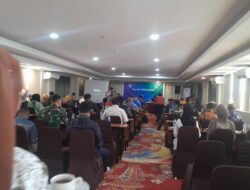
He made the remarks while addressing a strategic dialogue between the Deputy Minister of National Development Planning (Bappenas) and governors, regents, and mayors from across the six Papuan provinces in Timika, Mimika Regency, on Thursday, 30 July 2026.



Nawipa said Law No. 21 of 2001 on Special Autonomy for Papua marked the beginning of a new chapter for the region, particularly under the second phase of Papua’s special autonomy policy, with the aim of delivering lasting improvements over the next two decades.
He said that vision was reinforced through Presidential Regulation No. 24 of 2023, which established the Papua Master Plan (2022–2041) as the long-term blueprint for the region’s development.
The master plan was later translated into a five-year implementation framework through Presidential Regulation No. 107 of 2025 on the Papua Development Acceleration Action Plan (RAPPP) 2025–2029, which outlines 19 priority programmes to promote a Healthy Papua, Smart Papua, and Productive Papua, while aligning with Indonesia’s 2025–2029 National Medium-Term Development Plan (RPJMN) and the Asta Cita agenda of President Prabowo Subianto and Vice President Gibran Rakabuming Raka.
“In the national context, Papua plays a vital role in supporting economic growth and balanced development across eastern Indonesia through downstream natural resource industries, while contributing to the President’s Asta Cita priorities on food security, energy security, global climate balance, and investment that benefits the people of Papua,” Nawipa said.
He added that the six governors of Papua had introduced several joint initiatives through the Association of Governors of the Six Papuan Provinces. Their most recent meeting, held in Timika on 11 May 2026, produced the 12-Point Timika Agreement, which was signed by all six governors and formally submitted to the President.
The agreement includes commitments to support the President’s Asta Cita agenda; continue strategic national projects such as the Trans Papua Highway, the One Price Fuel programme, the Sorong Special Economic Zone, the Raja Ampat tourism destination, and industrial development in Bintuni, Fakfak, Nabire, Biak, Timika, and Merauke; accelerate infrastructure development in the four newly established autonomous provinces; strengthen oversight of Papua’s special autonomy funds; revise the Special Autonomy Law; increase Special Autonomy and Additional Infrastructure Funds; promote Papua as Indonesia’s sports province through a dedicated legal framework; strengthen the governors’ association; improve coordination with regency and municipal governments, representative institutions, and customary bodies; expand programmes for Indigenous Papuans in education, healthcare, social protection, and socio-economic data collection; ensure that Papua’s natural resources benefit all six Papuan provinces under the principle of “one for six, six for one”; and hold annual meetings to formulate strategic policy recommendations for the President.
Nawipa said the dialogue should strengthen coordination among all stakeholders involved in Papua’s development, noting that progress in the region requires collaboration between the central government, ministries, provincial and local governments, the Papuan People’s Assembly (MRP), provincial and regency legislatures, customary institutions, religious leaders, academics, civil society organisations, state-owned enterprises, the private sector, development partners, and the international community.
Without strong coordination, he warned, development programmes in Papua risk becoming fragmented, poorly targeted, and unable to address the region’s underlying challenges in a comprehensive way.
“We hope this dialogue will be more than a ceremonial event. It should produce strategic recommendations that serve as a roadmap for achieving Indonesia Emas 2045—beginning with the sunrise in the east, through equitable national development that starts in the Land of Papua,” Nawipa said. (*)